The Emergency Overdose Prevention Fund offers lessons in how we respond to immediate needs without losing sight of longer-term change.
The Emergency Overdose Prevention Fund (EOPF) began with a practical question: could making a group of urgent, community-led projects visible help funding reach them more easily? In many cases, it did. Funding moved, new relationships began, existing ones deepened, and more funders found a way into substance-use health. But making the gaps visible did not mean that every gap would be filled. That tension – between what the fund made possible and what it could not resolve – is one of its most important lessons for philanthropy.
The need for collective action
When our family foundation began supporting mental health and wellness in 2017, it felt natural to include substance use and harm reduction. We saw them as connected, yet relatively few foundations seemed to be intentionally funding this part of the work.
Meanwhile, the organizations we supported were piecing together short-term and often restrictive funding from multiple sources, each with its own processes and timelines. Time that could have gone toward the work itself was instead spent finding the money and meeting the different requirements needed to keep it going.
What stood out was not a lack of knowledge or ideas. Those closest to the work understood their communities and were best positioned to respond. Through our own granting, we had seen how long-term, flexible funding gave organizations room to act on that knowledge. But our foundation and the few other funders we were beginning to learn about could not meet the field’s needs. We began asking what role philanthropy could play where public funding was falling short – without suggesting that it could or should replace it.
We began asking what role philanthropy could play where public funding was falling short – without suggesting that it could or should replace it.
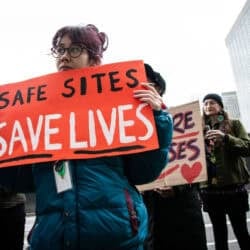
In August 2024, Ontario announced that 10 supervised consumption sites would close. The decision affected many organizations we supported in the substance-use-health space and reinforced the need for a broader response. The following May, in partnership with Catalyst Philanthropy, we heard from 35 advocates, researchers, people with lived and living experience, and representatives of community organizations across Ontario. They identified several opportunities for systems-level work, including a substance-use-health funding collaborative. Soon after, we began meeting regularly with community, other funders, and Catalyst to establish one.
The hope for the collaborative was always bigger than any one initiative. We wanted to bring more funders and funding into substance-use health, create space for funders and community to learn from one another, and support community leadership and capacity. Before that longer-term work had time to unfold, Ontario announced in March 2026 that it would withdraw the remaining provincial funding for overdose prevention and harm-reduction services, effective that June.
With public funding ending, organizations drew on their knowledge and relationships to remain connected with people who had relied on those services. For many, an overdose prevention site had also been a trusted source of harm-reduction supplies and a connection to healthcare, housing, food, and other support. Independently funded sites remained open but faced growing demands.
Building a response funders could join
The collaborative initially hoped to create an emergency pooled fund, with affected organizations deciding collectively how to distribute the money. But the model required trust, infrastructure, and a pool large enough to justify the time involved in community-led allocation. Many foundations would also have needed board approval to contribute and place allocation decisions with participating organizations. Those conditions could not be established simply because the need was urgent.
Long before working in philanthropy, I learned as a massage therapist the importance of listening and starting from where someone was. I later recognized that same principle in harm reduction. It also shaped how we thought about bringing more funders into substance-use health. Many were not ready to join a pooled fund, but they might be willing to consider a specific project and begin or deepen a relationship from there.
The Emergency Overdose Prevention Fund (EOPF) emerged from that realization. Rather than asking funders to contribute to a shared pool, it brought together community-led projects they could support directly. Some aimed to help independently funded sites respond to growing demand as other services closed; others focused on how organizations were adapting their work following the closure of their overdose prevention services. All affected organizations were invited to participate. Each participating organization completed the same straightforward template, and Catalyst presented 10 projects on a public platform. The EOPF launched on June 2, less than six weeks after the initial discussions, reflecting how quickly we were trying to respond as the funding landscape changed.
These different entry points helped us to meet funders where they were and to demonstrate how substance-use health connected with issues many already supported.
Foundations and individual donors could see what each project needed, what had been contributed, and where gaps remained. They could give online, contact an organization directly, or ask Catalyst to make a connection. Catalyst updated the pages as funding came in, posted an introductory primer on substance-use health, and hosted a webinar for funders who wanted to learn more. Catalyst and I also reached out directly to potential funders, using the projects to start conversations about how substance-use health connected with their existing priorities.
These different entry points helped us to meet funders where they were and to demonstrate how substance-use health connected with issues many already supported, including mental health, housing, and community well-being. The projects made those connections tangible and gave funders a practical first step without requiring them to understand the entire landscape.
Visibility was only the beginning
But putting the projects online was only the beginning. Funding moved through conversations, introductions, and follow-up. Some foundations could use the information gathered through the EOPF; others still required their own applications. Funders with whom we had no existing relationship were sometimes unsure why we were approaching them on another organization’s behalf.
Moving away from the pooled model made the EOPF more feasible within the circumstances, but direct funding meant working alongside each foundation’s processes rather than replacing them. We had not fully appreciated how much those processes would vary. We shared information about where gaps remained, but funders varied in whether they could use it to guide their decisions. We also had not made it clear enough that they could ask us for an up-to-date picture as other contributions were being considered.
Individual decisions, uneven results
The consequences became visible as funding came in. Several Toronto projects received the funding they sought, while the Ottawa projects remained unfunded. Some funders, we understood, were geographically limited to supporting projects in Toronto; other decisions reflected funder priorities and existing relationships.
Our foundation had kept part of its commitment unallocated so we could respond to emerging gaps, but the regional gap was larger than we expected. Directing our remaining funding toward Ottawa would help, but it would not meet the full need. We found ourselves back where we had started: able to see the gap clearly but unable to fill it alone.
Each funding decision might have made sense on its own, but there was no assurance that individual choices would add up to a fair collective result. This was one reason community decision-making had been central to the pooled model: participating organizations could have considered the projects together and distributed resources across the whole. Under the EOPF, each funder still decided independently where its money would go.
Broadening participation
None of this means that adapting the model was a mistake. Meeting funders where they were broadened participation and created some unexpected openings. After seeing the platform, an anonymous donor reconnected with an organization they had previously supported and made a new donation. A foundation offered a matching grant. A non-profit group also contributed, and several people redirected honoraria they would otherwise have received from our foundation.
That range of participation felt significant. I’m so very grateful to everyone who helped make the EOPF possible: the organizations that shared what they were experiencing and what was needed; the funders and donors who contributed; and the many people who offered input and feedback, shared the initiative with others, or championed it within their own organizations and networks. Many people put considerable care and effort into making it happen. The EOPF was structured so that everyone would have access to the same reporting and opportunities to learn, regardless of the size of their contribution. This offered a glimpse of what democratizing philanthropy could look like: contributing to and learning from a shared response did not have to be limited to established foundations or those able to make large gifts.
The limits of visibility
The experience revealed both the possibilities and the limits of visibility. The EOPF helped move funding, made the wider landscape easier to understand, and created more ways for people to participate. But a shared view of the needs did not, on its own, create shared responsibility for meeting them. These reflections are not a critique of the funders who took part or of the effort they made. They are a reflection on the model itself and what it might take for individual funding decisions to add up to a more coordinated and equitable result.
We also do not yet know whether the relationships created through the EOPF will last. A first grant can open the door to more dependable support; it can also remain a one-time emergency response. If the support ends there, organizations may once again have to find the next source of funding and repeat what they have already shared.
Over the coming months, we want to understand both what the projects made possible and what the EOPF can teach us as a funding model. Using indicators each organization selected, we will look at what they were able to continue, adapt, or test, along with shared themes and important differences across the projects. We will also ask participating organizations about their experience with the EOPF as a funding model and will hear from funders who contributed, as well as those who considered it but did not. What made participation possible or difficult? What should a future collaborative effort keep, and what might we do differently? Over time, we hope to learn whether the EOPF was enough of an entry point to lead to longer-term, more dependable funding – and, if not, what else would be needed.
Responding now, building for the future
The EOPF was not the work we expected the collaborative to take on first. It emerged when provincial funding was withdrawn and we felt compelled to respond, changing our timelines in ways we had not anticipated. It has made me think more carefully about how we respond to immediate needs without losing sight of longer-term change and sustainability. I do not think we can choose one over the other; we need to find ways to do both.
The fund emerged when provincial funding was withdrawn and we felt compelled to respond, changing our timelines in ways we had not anticipated.
This experience has also reminded me that there has been no instruction manual for running our family foundation. Much of the work has involved listening, responding as thoughtfully as we can, and being willing to adjust as we learn.
The EOPF has been part of that learning. It has not given us a finished model, but it has shown us more clearly what a coordinated and accessible approach to funding can make possible and given us a better sense of what to build from here.