An anti-poverty narrative is fuelling mounting criticism, public scrutiny, and political pressure on non-profits doing front-line work, leading some to question whether they have the support to continue.
A 2026 issues brief by the Ontario Nonprofit Network reported that organizations across the sector working to provide harm reduction, outreach, supportive housing, and addiction services are facing growing criticism, public scrutiny, and political pressure. In a moment where the need for these supports and services is rising, the question is no longer simply how to help those experiencing homelessness and addiction but whether the organizations doing this front-line work will have the resources, public support, and political space to continue doing so.
An uncertain future
In the heart of Kensington Market, a vibrant Toronto neighbourhood known for its local art, food, and vendors, one of the city’s last remaining supervised consumption sites stands, but its future remains uncertain.
The Kensington Market Overdose Prevention Site has been operating in the area, which has been identified by the City of Toronto as a “hot spot” for overdose-related deaths, for almost nine years. It all started when staff and volunteers at The Neighbourhood Group Community Services (TNG), then known as St. Stephen’s Community House, caught wind of grassroots work being done elsewhere in the city in the midst of a national opioid crisis. Some of these staff went to the unsanctioned, community-run pop-up clinic that was operating out of a tent in the Moss Park neighbourhood to learn how to reverse overdoses.

CEO Bill Sinclair says that as an organization that tries to respond to the needs of its community, TNG knew it needed to bring this kind of life-saving program to St. Stephen’s Community House. (In 2020, St. Stephen’s, a non-profit that had served the community for more than five decades, merged with other long-standing charitable organizations in the area, including Central Neighbourhood House and Neighbourhood Link Support Services, to become what is now known as TNG Community Services.) In 2018, TNG received a legal exemption to operate a supervised consumption on-site with funding from the province. After only one year, the province pulled its funding. The Kensington Market Overdose Prevention Site (KMOPS) has been privately funded since.
KMOPS was one of nine consumption sites that opened up across Toronto after the grassroots program first started in Moss Park in 2017. But now it’s one of the last few programs of its kind in the Greater Toronto Area, a region that has continued to see an uptick in drug overdoses in recent years. And it may not have much time left.
They’re saying that the [supervised consumption site] here can’t be next door to the childcare, and we’re saying of course it can . . . it can be done safely.
Bill Sinclair, The Neighbourhood Group Community Services
In 2024, the Ontario provincial government passed Bill 223, the Safer Streets, Stronger Communities Act, which prohibited safe consumption sites from operating within 200 metres of schools, childcare centres, and family centres. After the legislation passed, a wave of closures hit supervised consumption sites across the province. KMOPS was one of the sites scheduled to close, as TNG also operates a childcare centre next door. “They’re saying that the service here can’t be next door to the childcare, and we’re saying of course it can. We’ve run the services side by side, and it can be done safely,” Sinclair says.
About a week after the legislation passed, TNG issued a Charter challenge against Bill 223 for violating sections 7, 12, and 15 of the Canadian Charter of Rights and Freedoms. After the hearing last year, the judge issued TNG an injunction to continue operating until the final ruling comes through. The future of this supervised consumption site, and all the people that rely on its services, remains in the judge’s hand.
Echoes across the sector
Last fall, CASA Condos garnered national attention when it launched a multimillion-dollar lawsuit against Sanctuary, a neighbouring church and charity that has been part of Toronto’s downtown community for decades. The lawsuit claims that the drop-in centre permits “illegal, illicit, disruptive, interfering and egregious conduct” to occur in and around its property.
Pamela Uppal-Sandhu, ONN’s interim co-executive director and director of policy, says that staff at the organization heard about the story and decided to put a call out to their regional network to see if this was an isolated case or if other non-profits had experienced anything similar.
Sinclair responded to ONN’s callout, sharing his concern for Sanctuary and the legal battle that TNG was fighting against the province. And he wasn’t the only one: leaders and staff from across ONN’s regional network were echoing similar sentiments. After receiving a flood of responses from dozens of non-profits that had or were currently facing similar legal challenges and community backlash, ONN planned an emergency meeting with leaders from these organizations.
A coordinated group or individual . . . would start a campaign . . . And then that would turn into harassment, and then at some point that would turn into a legal suit.
Pamela Uppal-Sandhu, Ontario Nonprofit Network
Uppal-Sandhu says that before this meeting, ONN was under the impression that the sector was simply facing a growing number of legal challenges. This has also been described as “systematic legal attacks” – a term used here to mean coordinated efforts to use legal or judicial processes to penalize or burden non-profits that serve vulnerable populations, including people who are dealing with homelessness, mental health crises, or addiction. But after hearing some of the non-profit leaders’ testimonies, ONN realized that the root cause of the issue often started long before a legal case was brought to the courts. Uppal-Sandhu says that it would often start out the same way: “There would be a coordinated group or individual in the neighbourhood who would start this campaign against the organization,” she says. “And then that would turn into harassment, and then at some point that would turn into a legal suit.”
When asked why there seems to be a sudden increase in hostility against non-profits, many people interviewed for this story had similar responses. “Over the past few years, we have definitely seen this slow, gradual shift in the public narrative around our perception of poverty and mental health, including addiction issues, across the province,” says Candice Zhang, a policy advisor at ONN.
Although the anti-poverty rhetoric cannot be linked to any one factor, Zhang points out several that seem to be contributing to this narrative, including the global impacts of the COVID-19 pandemic, an affordability crisis, and an economic downturn that is only worsening with the ongoing trade war between Canada and the United States.
As more and more people experience the impacts of poverty in the current political and economic climate, it is becoming more visible in our public spaces. “You can see it on transit, in particular, and libraries and parks. And with that, we definitely see increased hostility against people experiencing poverty,” Zhang says.
‘Cleaning up the streets’
Ahead of the FIFA World Cup games in Toronto, the Toronto Underhoused and Homeless Union (TUHU) – an organization led by people with lived experience that aims to offer those experiencing housing instability a collective voice to fight against systemic injustices that affect their communities – heard from one of its allies about a case of escalated violence at Union Station. It was suspected that the increased security measures were linked to the city’s preparation for the FIFA games and the crowds that this mega-event would draw into the city.
Eddi Esteban, TUHU’s administrative and programming assistant, says that on their first community-outreach trip to Union Station, they witnessed an escalation of violence that targeted individuals who appeared to be homeless. Over a two-month period, TUHU collected the testimonies of 49 people and included their findings in a report titled Safety for Whom? The Human Cost of FIFA World Cup Preparations. The report documents increased “harassment, displacement, ticketing and violence” against those experiencing poverty, mental-health crises, and addiction in and around Union Station for weeks leading up to the FIFA games. Reverend Angie Hocking, one of TUHU’s founding members, told the CBC that there was a mentality to “clean up the streets” ahead of FIFA.
The testimonies TUHU collected and their report findings were consistent with patterns of other host cities around the world. Toronto Mayor Olivia Chow said that these heightened security measures were a part of a pilot project in collaboration with Metrolinx, the Toronto Transit Commission, Toronto Police Service, and outreach workers to connect homeless people to resources.
Esteban says that one community member was told to leave Union Station and given directions to a shelter. Complying with instructions, the individual went to the shelter, only to find out that it was full. With nowhere else to go, they returned to Union Station and were later subjected to violence from security.
In a press conference, Chow denied that the “pilot project” had any correlation with the FIFA games but that “the timing of it happens to be just before FIFA.”
Regardless of the stated intention, this pilot project illustrates how politicians and institutions can contribute to a growing anti-poverty narrative by framing poverty as a problem to be addressed by policies that push vulnerable communities out of public spaces.
Poverty creates a discomfort, and I think that increasingly the default is to blame the person, the individual, and we don’t look at the systems that are creating it.
Elizabeth McIsaac, Maytree
Elizabeth McIsaac, president of Maytree, an organization committed to advancing systemic solutions to poverty through a human-rights-based approach, echoes Zhang’s concerns about a hardening attitude toward visible poverty. “It creates a discomfort, and I think that increasingly the default is to blame the person, the individual, and we don’t look at the systems that are creating it.”
Whose neighbourhood is it anyway?
ONN’s conversations with non-profits revealed that the growing anti-poverty narrative is fuelling mounting criticism, public scrutiny, and political pressure on organizations doing front-line work. And more and more, this narrative is forcing non-profits into the courts, where they have to justify their existence and their right to continue existing.
Benjamin Miller, staff lawyer and policy advisor at ONN, says that non-profits win “99% of the time” when the legal cases filed against them reach the courts. But even so, the financial strain is considerable. Miller notes that much of these organizations’ funding is grant-based. “Grants cover the services; they don’t cover all this other admin,” he says. “It seriously compromises the cash flow and the financial sustainability of these organizations when all of a sudden they have large legal bills,” he says. “It puts an organization at risk, even if they’re in the right.”
In February 2024, Eric Gillespie, the lawyer for a group called Niagara Neighbours for Community Safety, filed a lawsuit against the City of Toronto and St. Felix Centre to dispute the establishment of a 50-bed shelter at 629 Adelaide Street West. The group’s legal case was based on a municipal zoning bylaw that declared the site was not permitted for use as a shelter. The group acknowledged that there is a “serious public health crisis of homelessness, addiction, and mental health” but that a shelter in the middle of a residential area means that the neighbourhood is bearing the result of decades of systemic failures. It expressed concerns regarding an increase in crime, drug use, and disorder.
This approach reflects a “not in my backyard” (NIMBY) attitude, in which residents may acknowledge the need to address homelessness while opposing the placement of shelters or supportive services within their own communities. As Zhang explains, “We’ve heard people say they’re not against poverty or against homelessness, but we just don’t want to see it in our neighbourhood.”
A month after the neighbourhood group filed their legal challenge against the St. Felix Centre shelter, the judge ruled against them and dismissed their case. The group appealed the decision multiple times over the next two years. Brian Harris, St. Felix’s executive director, says that the total cost of legal representation reached $100,000; the City of Toronto footed the bill. “The money that was spent could have been spent on actually helping people in the community that need help,” Harris says. After all the unsuccesful appeals, Harris says, the judge ordered the group to pay St. Felix Centre approximately $27,000. “To date, they’ve paid about $3,000.”
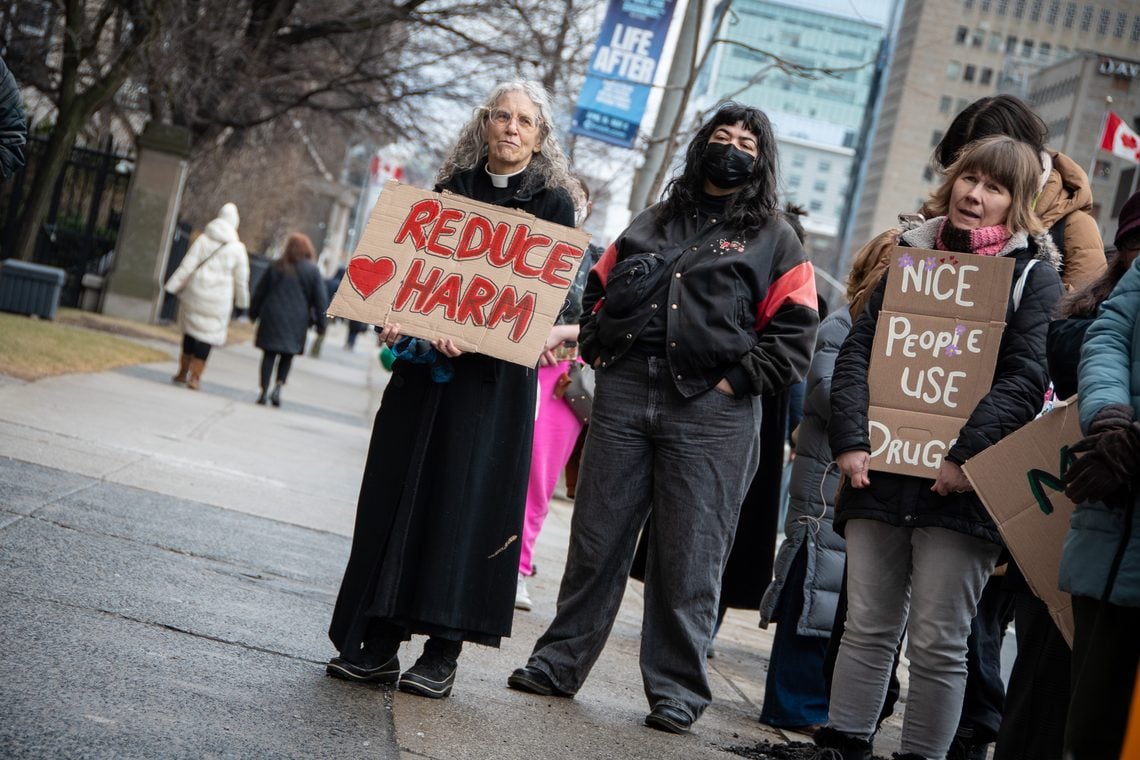
In September 2026, a new lawsuit was filed against the City of Toronto by Safe Neighbourhoods Toronto, a non-profit that incorporated in August 2026. The non-profit is seeking an injunction to halt the city’s establishment of multiple shelters that they deem unlawful, for a failure to “comply with criteria set by city council.” The St. Felix Centre is one of the shelters included in the lawsuit. “We want people to be able to have access, and get the dignity and meaningful support,” Diane Chester, a member of Safe Neighbourhoods Toronto who was also involved in the 2024 case against the St. Felix Centre, told the Toronto Sun, “but it can’t be at the cost of a neighbourhood.”
But the answer to how we make our neighbourhoods safe and inclusive for everybody might never be found in the courts.
Working together – finding solutions
During the pandemic in 2020, Melanie Joy, who is now an executive lead at the Toronto Drop-In Network, was working as the community engagement manager for a short-term shelter that was receiving significant pushback from members of the community. She began the process of community integration by establishing a community liaison committee chaired by representatives from business, institutions, and community residents. The goal was to give them the space to voice their concerns while also looking for solutions. “The approach that I took was the approach that I take in my own neighbourhood. One where I’m connecting with my neighbours because I care about my neighbourhood and I take pride in it and in taking care of it,” she says.
One initiative that came out of these meetings was a community safety team with a schedule that aligned with the nearby school. Joy says that every morning, the team would do a sweep and collect any harm-reduction tools that could have injured the children. They also coordinated with crossing guards and security guards to patrol through the area during break times to make sure the children were safe.
This example, where shelter staff and community representatives worked to ensure that the neighbourhood was safe while also allowing necessary infrastructure and housing programs to co-exist, is one approach to finding short-term solutions. But the reality is that the root cause needs to be addressed to find long-term, lasting solutions. “Homelessness is inherently a housing problem,” McIsaac says. To address the rising number of residents experiencing homelessness, the city needs to invest in reliable, safe, affordable, and accessible housing.
Shortly after Canada passed the National Housing Strategy Act in 2019, Toronto began developing a 10-year housing plan aimed at ensuring that residents have access to affordable and accessible housing. As part of that work, the city rewrote the Toronto Housing Charter – Opportunity for All, stating that “It is the policy of the City of Toronto to recognize that housing is essential to the inherent dignity and well-being of the person and to building sustainable and inclusive communities.”
The city also established a Housing Rights Advisory Committee, which McIsaac chaired for its first two-and-a-half years. But turning commitments into meaningful change takes time. “We’ve been working really hard,” she says. “But it’s slow-moving. It wasn’t like we suddenly had the power to make everything right.”
But even as cities like Toronto work toward a more inclusive future, the resources and support provided by non-profits on the front lines remain essential. However, the political, legal, and public challenges that organizations face only makes it more difficult for them to do this essential community work. As more legal suits are brought against non-profits, ONN believes that funders have an important role to play. Zhang says that funders should think about setting up an emergency fund to provide immediate financial support to organizations facing legal action. Miller suggests that funders could also contribute to establishing a “collective legal mechanism within the sector, so that it’s not every organization figuring it out for itself. Instead have a pooled and a scalable way to share resources and share expertise.”
But maybe even more importantly, Zhang suggests that funders support the work necessary to counter the growing anti-poverty narrative and educate the public on the work being done at front-line organizations. “Don’t be afraid to fund advocacy,” she says. “We definitely need more funding, so that non-profits can advocate for themselves and have their voices heard.”
Education is one of the most – if not the most – significant ways to stop the growing anti-poverty narrative, decrease public pushback against non-profits, and increase the pressure on politicians to implement policies and work toward long-term solutions.