From mission-aligned investments to grantmaking that supports generational movements, feminist philanthropy has myriad lessons for the philanthropic sector writ large.
Women’s and feminist movements have been a driving force in advancing gender equality around the world, from Egypt’s right to vote and Mexico’s abortion rights, to Sweden’s universal childcare and Canada’s family law reform.
However, these are not overnight successes. “Advancing gender equality does not happen on a 12-month or even 24-month timeline,” says Ruth Goba, executive director of the Women’s Legal Education & Action Fund (LEAF). “Philanthropists and donors should celebrate, not fear, making long-term investments in systems change.”
For a two-part series, The Philanthropist Journal interviewed leaders from eight organizations to learn more about feminist philanthropy and how it is responding to current threats, including authoritarianism, funding cuts, and anti-rights backlash. This second part focuses on how feminist philanthropy works in practice, from establishing funds and investment strategies to grantmaking practices and long-term movement-building. Although just a snapshot of the sector, these leaders’ experiences demonstrate how feminist philanthropy enables movements to not just meet the moment but also catalyze generational change.
Building and sustaining feminist funds
Some of the largest feminist funds and women’s rights organizations were established decades ago and have global reach. But by their own admission, they cannot respond to everything. Linked in part to the localization of philanthropy, more and more regional, national, and local funds are being established to invest as directly as possible in leaders, communities, and movements.
For example, feminist activists from the Middle East and North Africa had the vision of establishing a feminist fund in and for the region years before the Doria Feminist Fund was formally launched in 2021. The collective process of co-creating this fund through extensive consultations was rooted in feminist principles and critiques of conventional philanthropy. A key motivation was the determination to overcome the dearth and conditionality of funding for intersectional feminist movements in the region.
Feminist philanthropy requires critical engagement with the nature and sources of wealth – a kind of financial jiu-jitsu. “It is not a question of purifying the origin of capital,” says Gabriela Toledo, co-director of Fondo Semillas, “but of strategically reorienting it to strengthen the autonomy and expand the power of those who have been historically excluded.”
The Equality Fund also approaches the market economy with a combination of critique, pragmatism, and innovation. When the fund received a $300-million grant from the Government of Canada in 2019 – the largest investment in one organization under Canada’s feminist foreign policy – the conventional approach would have been to spend it down through grants. However, they decided to take a different approach from the start. As part of a broader shift toward mission-aligned investing, the Equality Fund created gender-lens investing criteria and a bespoke exchange-traded fund to proactively back advancements in relevant areas (such as women’s health and climate resilience) while also yielding financial returns. This strategy helps the Equality Fund reduce dependency on unpredictable sources of funding, build financial independence, mobilize and redistribute resources that meet the needs of feminist movements, and create a tighter feedback loop between their investments and their grantmaking.
“We know that feminist movements are here to stay, and the issues that they deal with are here to stay,” says Sana Mustafa, the Equality Fund’s interim associate vice president of philanthropy.
Even feminist funds that have gotten creative with impact investing still have to fundraise through institutional and individual philanthropy. They are not immune to many of the same challenges that non-profits face with short-term, restricted, and project-based grants.
When they are able to secure large, unrestricted grants from aligned funders, it can be transformative – not only for those funds as organizations, but also for the partners and movements they support with their own flexible, trust-based grantmaking. For example, Fondo Semillas used part of a US$6-million gift from Yield Giving (MacKenzie Scott’s vehicle) to establish the Sustainability Lab with six local partner organizations in Mexico. They are developing a five-year model, with each partner receiving an annual US$50,000 grant. As Fondo Semillas shared in a recent report, “flexible, long-term funding is a catalyst for social change and dignified activism.”
Feminist grantmaking: from trust and adaptation to innovation
Feminist philanthropy is rooted in trust and relationships. It respects the leadership, self-determination, and agency of the communities and movements it supports. As Mitzie Hunter, president and CEO of the Canadian Women’s Foundation, explains, this means sharing decision-making power with grantee partners, being flexible and responsive, and prioritizing and redistributing funds in communities that have historically been underserved.
Participatory and community-based grantmaking are core to feminist philanthropy. Grants are often multi-year and unrestricted (even when their own funding is not) so partners have flexibility to adapt to their changing contexts. A holistic and intersectional approach aims to address immediate needs as well as root causes of injustice and inequality. Support often extends beyond funding to include organizational strengthening, advocacy, and narrative change.
“We trust that the communities and the movements know what best works for them,” says Zeina Abdel Khalik, executive director of the Doria Feminist Fund.

Feminist philanthropy also applies a decolonial lens to its own grantmaking structures and practices. Organizations are largely staffed and advised by women and gender-diverse people from the communities and movements they are serving. Decision-making is grounded in proximity, lived experience, and local knowledge.
Feminist organizations that work internationally are also clear and intentional about their roles in the ecosystem. The Equality Fund grants directly to grassroots organizations as well as to women’s and feminist funds and regional funds that in turn direct resources to local groups. Decisions on who receives money are decentralized through country-specific and regional committees. “We have the positioning and power to unlock resources at the global level, and you know best how to redistribute it,” Mustafa says.
In challenging operating contexts, flexibility and adaptability are not just good principles; they are non-negotiable. In several countries, banking restrictions make it extremely difficult to transfer money to grassroots organizations and movements, especially if they are not registered non-profits or they are targeted by authoritarian regimes. Feminist funds in those jurisdictions have no option but to be creative and find alternative channels such as fiscal sponsorship.
You combat scarcity in movement-building by sharing resources in a way that honours the bottom-up approach and proximity.
Sana Mustafa, Equality Fund
At a time when funding cuts can fuel competition, even among aligned organizations, feminist philanthropy organizes in solidarity and focuses on what they have in abundance. As Mustafa says, “You combat scarcity in movement-building by sharing resources in a way that honours the bottom-up approach and proximity.”
Both the Canadian Women’s Foundation and Prospera International Network of Women’s and Feminist Funds shared examples of their respective partners and members pooling resources and creating non-competitive and participatory redistribution mechanisms. Through Prospera, members fundraise together externally and each fund is entitled to equal distribution of unrestricted grants, regardless of size. However, some choose to opt out of their share to ensure that other funds receive more in times of need.
As Prospera’s executive director, Laila Alodaat, says, reflecting on and shifting power within philanthropy like this is a way to both undo the “failures of the system” and actively reinforce the feminist funding ecosystem.
How feminist philanthropy responds in crises
Conventional humanitarian aid can be a lifeline in emergencies, but it is often short-term, restricted, and narrow in focus. It can also exacerbate existing structural inequalities and oppressive systems. Feminist philanthropy takes a more holistic and transformative approach, responding to intersectional vulnerabilities (for example, queer women with disabilities) while also addressing the underlying causes of crisis and violence.
In the Middle East and North Africa, activists and movements facing multiple compounding crises are “always responding to the urgency of the moment,” Khalik says. “You have to fund the rebuilding, the healing, and the infrastructure.” Feminist philanthropy also supports communities and movements to recover and to prepare for and better respond to emergencies in the future. The Doria Feminist Fund’s goal is for them to step out of survival mode and actually thrive.
This approach also shapes responses to natural and environmental disasters. After the 2017 earthquake and 2023 Hurricane Otis in Mexico, Fondo Semillas supported women-led emergency responses and long-term recovery beyond immediate aid and physical reconstruction. Investments in mental health, livelihood recovery, organizational capacities, and disaster preparedness centred women’s and girls’ specific vulnerabilities and needs, as well as their unique and often overlooked contributions to post-disaster response.
Feminist philanthropy doesn’t only respond differently in the moment of crisis; it also enables movements to build the relationships and capacities over the long term so that when – not if – the next shock hits, they have immediate reach and proximity to communities and can respond quickly and effectively.
The trust relationships that were created over the years . . . means that we don’t need to figure it out at the time of crisis.
Laila Alodaat, Prospera
During the COVID-19 pandemic, for example, Alodaat says that the ability to understand exactly what people needed and who was most at risk enabled them to rapidly direct funds where they would make the most difference. “The trust relationships that were created over the years in [Prospera] means that we don’t need to figure it out at the time of crisis. It is figured out and ready to mobilize,” she says. “The investment in [the ecosystem] has been preparing us for this very moment.”
Decades of investment in feminist, women’s rights, and environmental justice funds is paying off, with a large and growing ecosystem capable of responding to crises with agency, flexibility, and solidarity. Nurturing trusted relationships and prioritizing rapid, unrestricted funding enables communities, organizations, and movements to absorb at least some of the shock and strengthen their resilience against future crises.
How feminist philanthropy invests in movements
Feminist philanthropy backs movements for women’s rights and gender equality in several specific ways.
One defining feature is long-term investment, both through multi-year grants and by supporting movements over decades. Women’s and feminist funds play an outsized role in resourcing front-line communities and organizations at the intersection of gender, social, and environmental justice. They redistribute significant resources to movements around the world and have the capacity to greatly expand. Far from being just intermediaries, Alodaat says, “this is an ecosystem and an infrastructure that is getting the money exactly where it needs to go.”
Feminist philanthropy is effective when it ceases to be the protagonist and movements take centre stage.
Gabriela Toledo, Fondo Semillas
Despite this role, staying out of the spotlight remains key. As Gabriela Toledo says, “Feminist philanthropy is effective when it ceases to be the protagonist and movements take centre stage.”
Feminist philanthropy leans into its unique convening power. Women’s and feminist funds bring together local leaders, grassroots organizations, and other funders to share experiences, build relationships, and continue to learn and improve. “We do our best to develop and support a sense of community,” says Marie-Andrée Farmer, the Foundation of Greater Montreal’s director of strategic initiatives and community partnerships. “We’re trying to lead by example and share good practices with other funders.”

Peer learning also happens at the policy and institutional levels, with innovations developed in one context sparking others. For example, Sweden’s 2014 feminist foreign policy inspired several other countries, including Canada, to develop their own versions. The experience of the Equality Fund (established under Canada’s feminist foreign policy) with mission-aligned investing is now inspiring Sweden’s Kvinna till Kvinna Foundation to develop its own Nordic approach.
Feminist philanthropy is strategic about building and leveraging networks and partnerships. Through regional alliances such as Komboa in Africa and global networks such as Prospera, feminist funds can respond to threats and opportunities and access new sources of funding more effectively than each can do on their own. Strong partnerships are also an opportunity to raise visibility, advance the field, and mobilize more resources, including from governments.
Another pillar of feminist philanthropy is investing in collective organizing and advocacy. For example, the Foundation of Greater Montreal supports local organizations to self-advocate for appropriate housing and healthcare. Nationally, LEAF takes on strategic court cases to defend and advance legal protections against sexual assault and gender-based violence. In 2025, the Canadian Women’s Foundation joined national women’s organizations to successfully push back against proposed federal funding cuts. Across Mexico, Fondo Semillas supported grassroots movements for abortion rights, as part of the regional Marea Verde (Green Wave) movement.
Internationally, the Kvinna till Kvinna Foundation and Equality Fund are active in multilateral forums and advocate for shared aims such as protection of women and girls in conflicts. As a network, Prospera provides the connective tissue to strengthen alliances and facilitate access to information and decision-making spaces. Feminist philanthropy also engages in donor organizing, including with female and young donors, to increase overall investment.
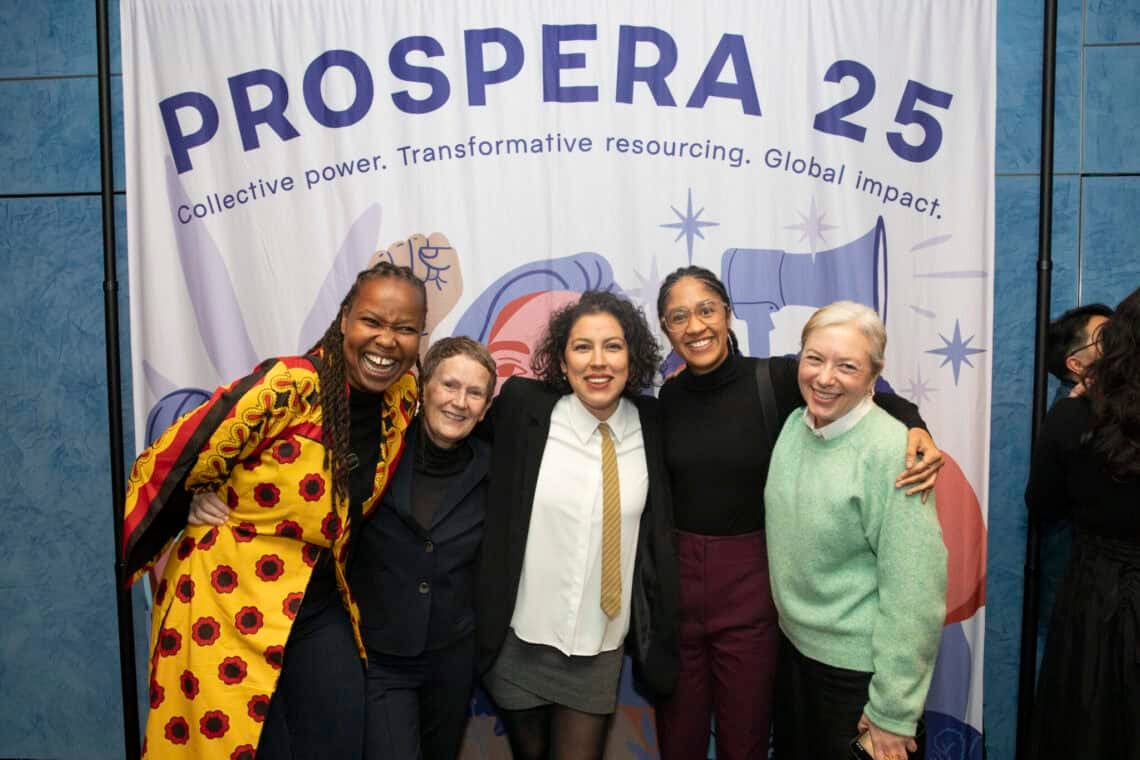
In feminist philanthropy, donor reporting is another opportunity to challenge power imbalances. With their grantee partners, women’s and feminist funds absorb as much of the administrative requirements as possible and integrate feminist critiques and approaches. For Prospera’s members, this is a political choice. “The more power you have,” Alodaat says, “the more burden you should take. You should lift the burden of those on the front line, not pass it to them.” At the same time, these organizations maintain rigorous accountability to their own donors (particularly governments), recognizing the limited margin for error and the high stakes of their responsibility to the movements they support.
The more power you have, the more burden you should take.
Laila Alodaat
Documentation is another key investment that underpins the others. Feminist philanthropy supports activists and movements to share their own stories, challenge harmful stereotypes, increase visibility, and build narratives that are rooted in local realities. Building evidence and intersectional analyses from the ground up and in diverse contexts – of both struggles and achievements – brings to light issues, initiatives, and trends that may otherwise go unreported. Communicating the myriad ways in which investing in gender equality contributes to society-wide priorities – including health, climate, economies, and democracy – also helps inform decision-making and attract broader support.

Key lessons and insights for philanthropy
Feminist philanthropy might seem niche or out-of-reach to some, but it has no shortage of common-sense and practical lessons for the philanthropic sector as a whole.
Money is power: how you use it, and the access, privilege, and security that comes with it, is a political choice. Critically assess your role in the system and how you can help transform power imbalances. Trust and centre the leadership, agency, and dignity of the people and communities who are closest to the issues you are seeking to address. Align your internal systems and practices with your values and external vision. Invest in relationships, movements, and ecosystems long-term. Lean in – don’t pull back – and stand with them during crises.
Think and act in solidarity and with abundance, courage, creativity, and humanity. Connect the dots with other causes to strengthen cross-sector alliances and build broader constituencies. Continue to listen, learn, share, and evolve with humility and intention; just like societal change, organizational and sectoral change do not happen overnight.
These are just some of the many lessons from feminist philanthropy that, if applied in the sector more broadly, could have wide-ranging ripple effects, far beyond what any individual or organization could do on their own. This work is collective, steadfast, and inherently optimistic. It is about planting seeds today for the trees that will provide shade and bear fruit for future generations.
As the Doria Feminist Fund writes, “Here we are, bent on marching together towards a feminist future of justice, freedom and joy.”