New research reveals a dynamic, self-assured, and growing climate justice movement in Canada. Four actionable themes emerged about what this movement needs now and how funders can grow its impact and power.
How can we advance climate solutions in Canada that also address our country’s real and growing economic, social, and health needs? This was a key design question for the Trottier Family Foundation last spring, as they partnered with a team from Catalyst Philanthropy on a strategic process to diversify their climate funding and deepen their climate justice efforts.
Climate justice work starts from the premise that when people experience real material impacts from climate policies – through access to good-paying jobs, shorter commutes, easier access to healthy food, and safe air, land, and water – they will champion those solutions in their communities and at the ballot box. These are the kinds of community-level climate solutions that people talk to their neighbours about, with comments like:
“My daughter just got a job at the new solar power station!”
“Did you see how much faster it is to get downtown with the new buses?”
“My new heat pump has brought my winter bills down by 30%!”
“The oil company is finally cleaning up the old well on my land and we’re going to be able to use that area for farming again.”
The leaders best placed to realize these solutions are those most connected to the communities they serve. In North America, these climate leaders often hail from working-class, Indigenous, and racialized communities – which also happen to be the communities that have traditionally been most excluded from climate policy development, marginalized by underinvestment, and overburdened by polluting projects. Investing in these leaders and the community-benefitting policies they champion therefore has overlapping benefits: advancing climate policies that are popular and effective, that also address existing economic, social and health inequities. This is climate justice at work.
To support Trottier in exploring how to further integrate climate justice into their overall funding strategy, the Catalyst team conducted eight weeks of research, 20 interviews with climate justice leaders and philanthropic funders, and multiple consultations with Trottier Foundation staff. The result was a collaborative process that, in addition to targeted recommendations for Trottier, led to a series of published profiles of the interviewees and a co-authored report, Climate Wellbeing and Community in Canada: How Investing in Community Leadership, Green Jobs and Policies That Make People’s Lives Better Can Build a Winning Environmental Movement.
Our research, interviews, and discussions revealed a dynamic, self-assured, and growing climate justice movement in Canada, with leaders who are punching far above the weight of the systemic underfunding of their work. We left the process inspired by these leaders, who ironically often receive more recognition and funding for their efforts internationally than at home. With proper support, the impact and power of Canada’s climate justice leaders and movement can continue to grow across the country.
Below, we’ve summarized four surprising and actionable themes that emerged from the interviews, about what this movement needs now and how supporters of the sector can provide catalytic impact across the field.
More climate workers, please!
. . . key jobs are going unfilled while training and apprenticeships lag
Despite making up only 5% of Canada’s population, First Nations, Métis, and Inuit organizations are partners or beneficiaries in nearly 20% of the country’s electricity infrastructure – and the Indigenous clean-energy field still has massive potential to grow. James Jenkins, executive director of Indigenous Clean Energy, talked about the training bottleneck his organization faces when it comes to the essential but less glamorous work of post-installation maintenance and repair of clean-energy systems across the country.
Melina Laboucan-Massimo of Sacred Earth sees the same gaps in the Indigenous community-owned clean-energy projects that her organization helps develop: “A lot of people don’t have that on-the-ground, hands-on installation experience in the climate movement.” Sacred Earth is filling that gap with trainings and accessible guides to help communities skill up. This was a key theme that emerged from the interviews: climate justice groups are stepping up to develop their own training and mentorship programs to keep the talent pipeline strong in Canada – but need support to do more.
A lot of people don’t have that on-the-ground, hands-on installation experience in the climate movement.
Melina Laboucan-Massimo, Sacred Earth
In Calgary, Black Eco Bloom is bringing young Black women into environmental work with a climate-adaptation fellowship developed in partnership with the city. Working with professional mentors in urban climate adaptation, Black Eco Bloom fellows work with local communities to develop climate-adaptation projects that meet their needs – and make new professional connections along the way.
Jeff Cyr of Raven Indigenous Outcomes Funds is developing his own “community solutions teams” to support the multimillion-dollar investments he’s helping to bring to Indigenous communities across the country. “We drop in specialists for a few months on specific project issue areas . . . to transmit knowledge and skills, cover bandwidth gaps, and make sure that the local community is ready” when the project is set to launch.
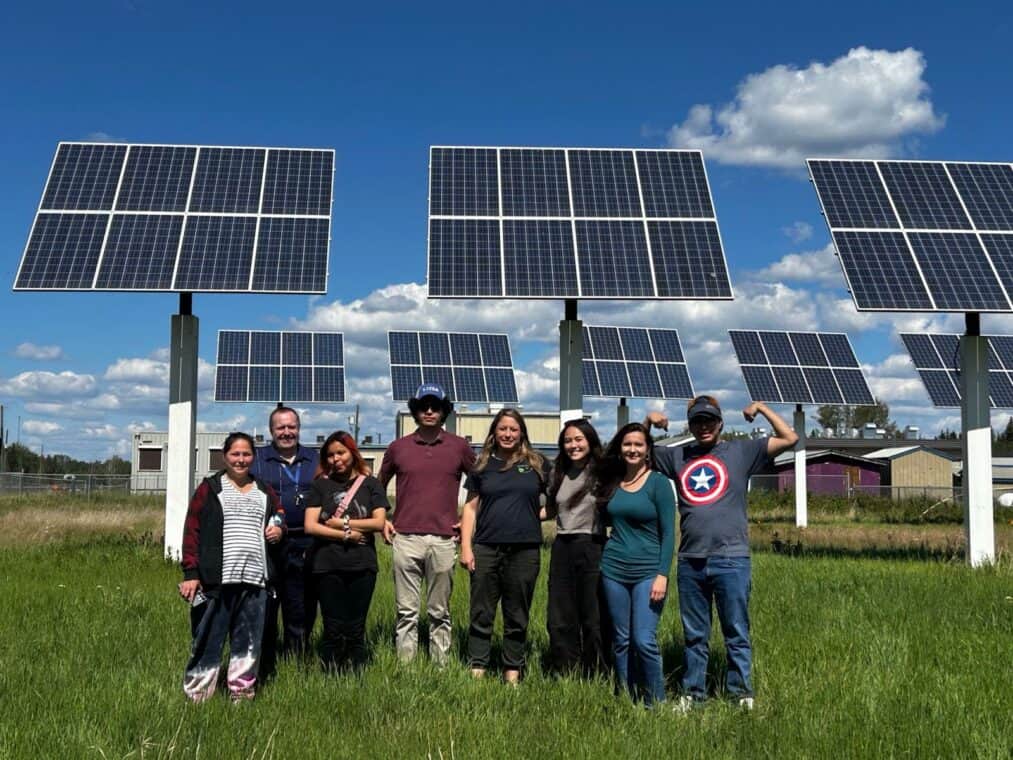
In rural and remote communities, the need for an active talent pipeline is even more acute. Stephen Ellis, northern program lead at MakeWay, described how the question of who will be doing the work is the single most important factor in determining whether a project goes forward: “We say this all the time: we invest in people, not programs. We don’t fuss too much if the program isn’t fully developed if the person is solid. We fuss a lot if the paper looks awesome but it’s written by some consultant, and there’s no one actually going to implement it in the community.”
The ask from Canada’s climate justice community is clear: across the board, leaders are looking for less short-term, restricted, and project grants with significant applications and reporting – and more support for the training programs that are already in place across the country, to keep the talent pipeline for the green economy strong.
Connect climate leaders
. . . through training, shared theory, and meaningful time together
Another key theme that emerged from our interviews and conversations with climate justice leaders was a real hunger for connection, time together, and space to develop shared analysis across the movement. Amara Possian, former Canada team lead for 350.org, emphasized the ongoing impact of the COVID pandemic on face-to-face organizing skills: “People can’t talk to people they disagree with. They can’t talk to people in general because they lost those skills during COVID. The pandemic broke the mentorship gap that typically exists in universities and colleges, where as you’re becoming politicized, you’re also mentored by the older generation of students – that just didn’t happen. There’s so much rebuilding to do.”
Multiple interviewees spoke to a desire to have more in-person time together and mourned the loss of face-to-face organizing gatherings that had previously been funded by philanthropic leaders, labour groups, and non-profits. Black Eco Bloom’s Tyjana Connolly spoke about how more traditional conference gatherings don’t scratch the itch of relationship-deepening that so many are seeking today: “I am in awe of the way that the US climate justice movement organizes. They just are together in a way that I don’t think we have here yet. There’s food, there’s music, there’s colour . . . in Canada the colour is missing, even on the walls! It just seems a little bit less lively in that way. I wish that we had more opportunities to organize where we’re just building community.”
The full strategy is based on understanding political theory and how transformative change happens.
Eriel Deranger, Indigenous Climate Action
Eriel Deranger, founder of Indigenous Climate Action and winner of a 2024 Climate Breakthrough Award, described how in-person gatherings are not only about building relationships between organizers, but also about developing shared analysis around the “why” of campaign tactics and strategy: “There is a retraction happening in the climate movement right now. Very few organizations are holding action camps to train people to understand the political theory behind why we engage in non-violent direct action and civil disobedience. We have a whole new generation of young people that are angry and disenchanted with systems and societies and capitalism that think that the strategy – like, the full strategy – is disruption, when it’s not. The full strategy is based on understanding political theory and how transformative change happens.”
Relearning how to speak to strangers and organize face-to-face. Strengthening the relationships that make climate organizing meaningful work and also allow coalitions and collaborations to function. And developing a shared north star for why movements deploy the strategies and tactics they do, and the histories behind them. On so many fronts, these leaders expressed a hunger and desire for more meaningful time in person, to make the climate movement stronger, more connected, and more purposeful.
Keep people in the work long-term
. . . with supportive networks and burnout recovery
Between low pay, long hours, and the need to focus on incremental victories against an existential threat to life on Earth and everything we hold dear on it, the climate movement is notorious for burning out and losing its best activists and leaders before their time. MakeWay’s Stephen Ellis sees it every day in his work north of the 60th parallel: “People are burning out, they’re too taxed, and there’s not enough support behind them. There’s no shortage of ideas or fixes that people want to test. The big question, though, is who will do the work? Leadership capacity and wellness are the fundamental bottleneck. It’s a mix of developing the next generation of leaders and supporting those already in leadership roles.”
People are burning out, they’re too taxed, and there’s not enough support behind them.
Stephen Ellis, MakeWay
Julius Lindsay of the Prismatic Project talks about the additional burden carried by Indigenous and racialized leaders in the field: “There is so much burnout. There is so much harm, so much fatigue, just fighting for people to take you seriously. Leaders who are BIPOC [Black, Indigenous, and people of colour] or from marginalized communities, they need that . . . sometimes you need a sustained period of rest.”
While some sectors have focused more deeply on the economic and social value of retaining senior leadership over the long term, the climate movement has been slow to create practices and structures that keep knowledge and talent in the field. More funding is needed to support this crucial work.
In the field, Sacred Earth distributes small-scale Healing Justice grants to support Indigenous land defenders coming off the front lines of struggle, so they can rest and heal from work that can be exhausting, traumatizing, legally precarious, and often unpaid.
At MakeWay, former CEO Joanna Kerr describes how they’re starting to fund time for climate leaders to restore and connect with each other: “Climate justice is about the resilience of front-line leaders for the long game . . . MakeWay funds several networks of leaders who have been on the front line of very difficult work. There needs to be this, times 100, in the movement.”
Let leaders experiment
. . . with new ways of organizing, strategizing, and building movements
“The landscape that we’re working in right now is really, really different than it’s been over the last decade,” says Amara Possian. “Our [in-person and digital organizing] tools are from a different time. And the only way forward is to experiment and learn in a rigorous way, and then to systematize things that are working.”
The problem? Climate funders are reluctant to back these kinds of experiments, Possian says: “That work is not funded because it’s risky – it might not work. There isn’t a silver bullet; there’s only experimenting, learning, and adapting. We need to build the capacity to meet this moment, try new things, and do more of what’s working and let go of what’s not working.”
There isn’t a silver bullet; there’s only experimenting, learning, and adapting.
Amara Possian, formerly 350.org
For the Trottier Family Foundation, the insights from this research are landing at a formative moment – as the team refreshes its climate granting strategy. Trottier is approaching community-rooted climate leadership with curiosity, beginning through small, flexible grants in partnership with Small Change Fund to build relationships with leaders and organizations that are often overlooked by mainstream philanthropy. The foundation is treating this early phase as a learning process: the goal is to understand what community-rooted climate organizations need, and to integrate those insights into Trottier’s broader climate strategy in a way that is responsive and grounded in trust.
The challenges facing the movement are real: climate issues have moved to the back burner for many governments, face-to-face organizing skills dropped off during the COVID pandemic and have been slow to restart, and engagement rates with traditional campaign tools like email and digital actions have plummeted. But young leaders like Manvi Bhalla, executive director and co-founder of Shake Up the Establishment, are up for the challenge: “You can trust young community organizers to find new, creative, and savvy public-policy interventions that meet the moment. Their approaches might not reflect the past 25, 50, or 100 years of community organizing, but that’s usually a good thing – and it’s what the moment demands of us.” Climate justice leaders are clear that this is the time to develop new tools and approaches for the movement – and philanthropy has the flexibility to take these kinds of calculated risks where other funders cannot.
Conclusion
Our 25 hours of research and conversation with leaders and funders across Canada gave us a glimpse of an energized and growing climate justice movement that is already delivering impact far greater than the amount of funding they receive.
The potential impact of this movement has only begun to be felt: these leaders are clear about the purpose and impact of their work, and the support they need to take it to the next level. By investing in bringing new people into the field, connecting them with time together, keeping them in the fight long-term with burnout-recovery programs, and providing space and funding to develop the next generation of organizing tools, funders can help build a more lasting, powerful, and resilient climate movement in Canada; one with the strength, momentum, experience, and strategy to build widespread popular support for climate action, support the well-being of communities, and win change on the scale this moment requires.