Across the support sector, many workers are struggling to provide critical support to vulnerable populations amidst circumstances that they have less and less control over.
Emmanuel Akanbi is one of five writing fellows working with The Philanthropist Journal and a partner outlet over the next year. Rideau Hall Foundation has awarded funding to The Philanthropist to support five Black and Indigenous early-career writing fellows in collaboration with five independent, local journalism outlets across the country.
“We’re excited to see how this approach supports the learning and development for the fellow, builds stronger connections with publications and our readership, and brings new voices and content – all while supporting the critical role that local journalism plays in communities across Canada,” says Leslie Wright, executive director of the Agora Foundation and editor-in-chief of The Philanthropist Journal. “We believe good journalism matters more now than ever – and the profession needs a diversity of early-stage journalists from across Canada who see themselves in this field helping to rebuild trust through fair and comprehensive reporting.”
Emmanuel Akanbi is the co-founder of local news website Antler River Media Co-operative.
At the beginning of her support-work career, Makayla Pegg felt optimistic about the work she was doing. “A lot of newer people were very young then. Fresh out of school, very idealistic, looking for an opportunity to better what they were seeing in the world,” she says.
Pegg started her career in Northern Ontario, at a residential living centre for youth with dual diagnosis, commonly referred to as “high-acuity” patients. Many of the youth were in the foster care system. Some were unable to live with foster parents because of their behavioural needs. Her first foray into the world of support work after college saw her facing an extremely intense, yet all too common, work environment. Violence against support workers was common, staffing was minimal, hours were long. “We were doing seven-on, seven-off continentals, so 12-hour shifts, 84 hours every two weeks,” Pegg says. “Frequently, you’d see staff come in for their 12 hours and get asked to stay for a night shift because one of the two staff would call out. So you’d see staff pulling 24-hour, 36-hour shifts.”
Pegg was in the role for only six months before eventually looking for work in London, closer to her family, but in that time saw the volatile work environment trigger a rapid staff turnover. “I was kicked across the living room in my six months there – I had a couple of friends sustain traumatic brain injuries while working there,” she says. “We were working for $17 an hour.”
Harsh conditions, no systemic change
Londoners have been doing support work for decades in harsh conditions, but systemic change seems to have taken the wrong direction. As with support work of all varieties provincewide, staffing has been cut and the number of agencies providing support to the most vulnerable populations seems to be on the downturn. All the while, the work has become more dangerous and less secure.
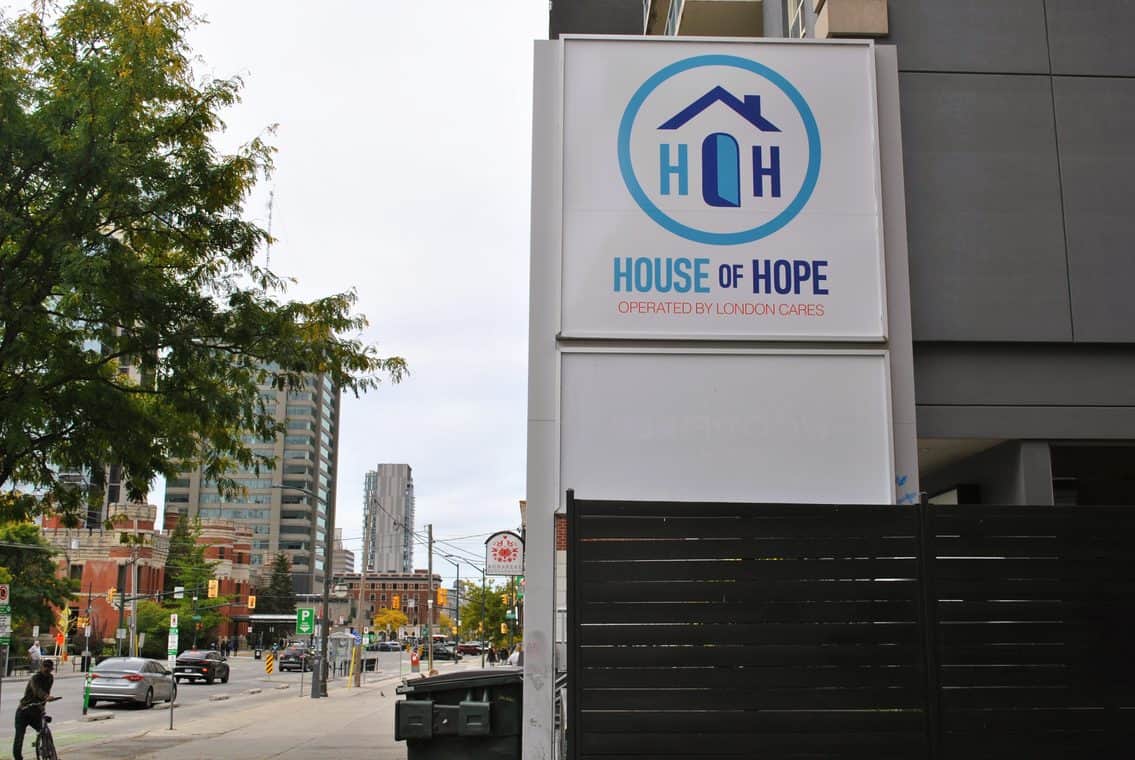
The past year has painted a daunting picture for vulnerable members needing support in London. Carepoint, the only supervised consumption site in the city, lost funding and shut down in June. SafeSpace, a drop-in centre and shelter for sex workers and women in crisis, had to close because of lack of funds as well back in May. Even House of Hope, a supportive housing program operated by London Cares, was slated to shut down by November – a fate now temporarily delayed thanks to a philanthropic donation from the London Community Foundation.
With blow after blow to the infrastructure that keeps vulnerable populations afloat, support workers’ optimism for a better tomorrow has faded. “There has been an escalation of many co-occurring crises that have all worsened simultaneously,” says Daniel Oudshoorn, a front-line community care worker who has spent nearly half of his 28-year career in London providing housing support with Sanctuary London. “Around employment, around rental costs, around the loss of permanent full-time benefited jobs, more and more people going to the gig economy, or people just losing jobs at factories and not finding that they can get employment elsewhere.”
There has been an escalation of many co-occurring crises that have all worsened simultaneously.
Daniel Oudshoorn, front-line community care worker
Oudshoorn notes that these economic losses are exacerbated by the erosion of services that provide care for people who are impoverished. When he first started in London, a little time could go a long way. “If I could spend a little bit of time with a person, I would be able to support them in getting all of the basic areas of need in their life met,” he says, referring to basics like access to housing, income stability, support programs, or even healthcare. But in 2026, doing any one of those things can prove to be a significant challenge. “The opportunity to find alternative support for those people who are cut out of that system has been extinguished, has been exterminated by the shifts in the funding,” he says.

As these shifts occur, wait times for supportive housing have gone up, forcing city-funded organizations like London Middlesex Community Housing to change their eligibility, leaving very bleak alternatives. The “urgent” status for social housing applicants established by the city in 2005 might be going away altogether. This leaves few options for applicants who have disabilities, are at risk of violence, or are presently homeless.
Though “urgent status” implies a quick pace, people on the wait list have waited upward of three years to get into supportive housing, an incompatible timeframe with the harsh realities facing many. “That’s three years in a tent by the river – if you survive, if you don’t die, if something else doesn’t happen,” Oudshoorn says. He recalls speaking to a veteran in his late 70s who did not qualify for urgent status and was added to a 12-year wait list. “He’s like, ‘I’m going to be dead long before my name gets pulled for this housing.’’’
The whole system has become steadily more dehumanized.
Daniel Oudshoorn
Other systems have also seen changing criteria and centralized automation affect how those needing support are able to access it, which leaves Oudshoorn with fewer and fewer ways to support the people he works with. In the past, he could speak face to face with an Ontario Works worker in London to explain why a client was unable to attend a necessary session to receive the funding, but now, he says, the local workers don’t have the authority to make decisions about waiving requirements. “The whole system itself has become steadily more dehumanized as it’s become increasingly more bureaucratized and made efficient and mediated through technology rather than people making decisions,” he says. “Now a lot of times when people come to me asking, ‘Hey, can you help me with X, Y, or Z?’ I have to say, I probably can’t,” he says, sighing. “But I can treat you like a human being before you go back to your tent and die tonight. That’s what I can do.”
From making a difference to becoming a business
This loss and “moral injury” Oudshoorn describes is felt across the support sector, with many workers struggling to provide critical support amidst circumstances that they have less and less control over. But with unstable and low wages, very few workers have the financial luxury of being able to take extended breaks from work. All the while, separating work from life becomes nothing short of impossible.
“I knew this was going to be my career. I knew there were full-time jobs available – but that’s not the case now,” says Lisa Fewster, president of OPSEU Local 166, the union representing workers at Community Living London. In her 35-year tenure supporting adults and children with developmental disabilities with the agency, she has seen part-time employment skyrocket. “It is hard for the retention because people need those benefits and the vacation,” she says. “They just don’t get that [working] part-time. So they’re working two and three jobs to make ends meet. And it just – it never ends.” Even before a 13-week strike earlier this summer, Fewster knew of several Community Living London workers relying on food banks to make ends meet.
Like Oudshoorn, Fewster has seen a rise in wait lists affect her work environment. As service provisions are limited, patients needing the specific care of an agency like Community Living London are placed in hospital psychiatric units, which she views as a cost-saving measure by the province.
More and more of the people coming off the wait lists are patients dealing with dual diagnosis or extreme behaviours that very frequently lead to violence. “The injuries that come out . . . our last house that [Community Living London] opened, they had a turnover of between 40 and 60 staff in less than a year,” Fewster says. “There was always a level of [extreme] behaviours even when I started, but not like it is today.”
With the majority of staff at support homes like Community Living London not employed full-time, the only reprieve for workers after an injury comes from Ontario’s Workplace Safety and Insurance Board (WSIB). But that itself was a negotiated benefit that the union fought for, and flaws within WSIB’s system make it unreliable for many workers, according to Fewster. “If [staff are] lucky enough for WSIB to approve their case, then they get what they get through WSIB and not much more,” she says.
There’s an air of hopelessness to the hardship that support workers face, with injuries rising and pay not keeping up, but their passion is still evident when they speak of their impact. Fewster recalls taking some clients on yearly field trips to Toronto to allow them to enjoy their lives outside of group homes; Oudshoorn shares the little moments of unhoused community members asking about his kids. For Fewster, the people she supports are like family. For Oudshoorn, they are loved ones. “These are people we know intimately well: we are part of a beloved community, and we are seeking to engage in a mutually liberating solidarity of care in the midst of oppressive circumstances,” he says.
I can remember a time when we would go in and we would make a difference. Now it’s just a business.
Lisa Fewster, OPSEU Local 166
As times change, funding has waned. There is no longer the capacity to share caring little moments with everybody. As client needs get more complicated, the dedicated hours for individual care can’t keep up. High-functioning patients who have been able to live on their own and just needed more routine basic care are moved into nursing homes as young as 50: the agency wouldn’t increase dedicated time for care and there was no space at group homes. “I can’t provide the care and the support that they need because I’m being told, ‘Well, they only get two hours a day, so you can’t do more than that,’” Fewster says.
But that agency response is unsatisfactory for these individuals’ families, frustrated that their loved ones are moving farther away from them. The frustration spills over to Fewster’s own emotional burden of knowing that she would do more if she could, a burden felt across her union. “I can remember a time when we would go in and we would make a difference. Now it’s just a business,” she says.
Loss of supports is easily preventable
Oudshoorn laments the gap he feels with other Londoners, many of whom can’t begin to imagine the amount of loss he’s seen. What hurts him the most, though, is how preventable this all is. “Where we as front-line workers get especially devastated is, like, these deaths are not statistics to us,” he says. “We can do much about all of these deaths caused by forcibly impoverishing people, forcibly displacing them, driving them away from anywhere that’s safe, taking away any community space where they start to feel care for one another.”
For Oudshoorn, the wins come through meaningful avenues to create change. Being able to get someone into housing is a tremendous feat, as is getting someone to see a doctor, helping someone access safe drug supply, or even helping someone have a safe environment to use substances without risk. But one by one, these avenues have been closed, and the fight to effect change becomes defending what was won. “It felt good to be able to do all those things,” Oudshoorn says, “and taking away the ability to do so much of that now . . . It just leaves workers feeling like ‘Well, what the hell am I doing here?’”
For most Londoners, the worlds that these workers live through might seem far away, especially the sorrows that come with them. However, the worlds feel closer together when it comes to the education sector. “A lot of the kids with special needs don’t have the proper support,” says Ben Fraraccio, a student supervisor with the Thames Valley District School Board.
Fraraccio has worked as a student supervisor since 2022, supporting teachers and educational assistants during lunch breaks and recesses. He’s had to handle anywhere from 50 to 70 students on his own, an overwhelming task as violence in schools becomes much more common. But funding from the province is not keeping up with the rising need for support in classrooms, according to Fraraccio. “It’s fairly typical for us to be understaffed – it’s only getting worse,” he says. The Ford government’s 2026/2027 Core Education Funding report projected a 1% increase in provincial education funding and cut $56.4 million from the Classroom Staffing Fund. At the beginning of last year, there were five student supervisors at a school Fraraccio worked at; by the end of the year, the board had to cut down to only two.

While London’s student supervisors are expected to handle larger class sizes and escalating circumstances, they’re losing the ability to work sufficient hours to access worthwhile pay or benefits. CUPE 7575, the union representing education workers in London like Fraraccio was able to organize benefits for student supervisors who worked a minimum of 15 hours a week, but with funding cuts “there is no pathway to benefits now,” according to Fraraccio. “I’m working just under an hour and a half a day instead of two hours. So over the week, that’s a serious cut to my pay.”
With the hours already not enough to subsist on, it’s likely that community members will decide it’s not worth it – meaning even less support for London’s students.
***
Support workers across London are feeling the urgency of their jobs grow as their ability to make a difference shrinks. But they know where to find support and what changes they would like to see, and most of those things come from themselves.
Fewster and Fraraccio speak of their work with their respective unions, and how they fight to ensure that their work is safe and respected. The advocacy work OPSEU did during the 13-week strike gives workers hope that things can someday improve.
Oudshoorn, who is currently on medical leave to cope with the loss he has felt, speaks of mutual care networks, and how pivotal they have been for him to keep fighting. Since medical leave means he receives only 55% of his wage, provided by employment insurance, some of his colleagues and community members came together and fundraised to ensure that he could still pay his bills on time. “Finding ways again to care for each other, to lighten each other’s load, to create spaces for each other to take a break,” he says. “Workers do have a great deal of power if they choose to be courageous and collective in their approach . . . but everybody’s just barely getting by these days.”