This is our first story in a new series that will celebrate those rare individuals, the unsung heroes, who are the heart and soul of their organizations.
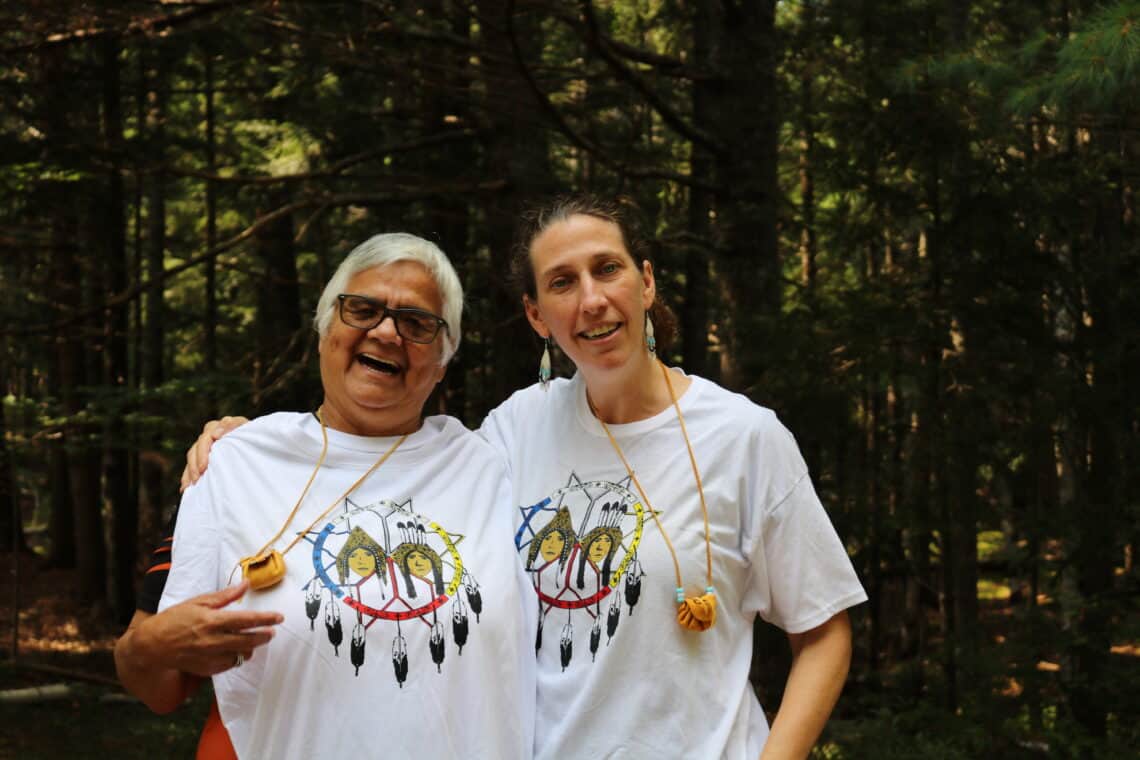
Grandmother Marilyn Francis (Wasoqopa'q First Nation) is a fighter: equal parts toughness and generosity. Beginning in 1986, when she moved with her young children to escape violence and gangs in Boston to her ancestral home in the Mi'kma'ki region of Kespu'kwitk (southwestern Nova Scotia), Marilyn has offered Mi'kmaw language instruction and traditional teachings in a variety of educational settings, as well as support work for survivors of residential schools. A perennial focus is connecting young people to their language and to Mother Earth through ceremony, paying forward the teachings she learned from her grandmother, mother, and other traditional knowledge keepers and language holders. For the last three years, she’s shared her knowledge and teachings through programs at Asitu'lɨsk, a land-based learning centre west of E'se'katik (Lunenburg) run by the Ulnooweg Education Centre, an Indigenous-led charity.
Marilyn’s role at Asitu'lɨsk is indispensable; without her, the camp couldn’t do what it does as well as it does. She’s an ideal candidate to launch this series celebrating those rare individuals who are the heart and soul of their organizations. This series will explore how individuals like Marilyn are able to do what they do by examining the spiritual and emotional resources that sustain them. In this column we’ll return repeatedly to some key questions and topics, like what sparked someone’s desire to do good work, and how they’d articulate their philosophy of care. We’ll ask them to share the most difficult part of their job, and outline any significant change, whether policy, workplace, or societal – “the big idea” – that they’d like to see in action.
As Marilyn’s thoughts and comments below illustrate, this column is not about care work, per se, but the work that goes into caring.
The spark
“I believe in ceremony. I believe in our ways. There’s nothing that can take me away from that spirit. I just love it. It’s kept me in a good way,” Marilyn says. “It’s gotta be your everyday life. Like when I get up in the morning, I say my prayers. It’s always about gratitude. First and foremost is Creator.”
How faith matters
“If I didn’t know these ways,” Marilyn says, “I would probably be a lost soul somewhere with no connection with my family, or with my ancestors, or with the land, or with the trees, or with anything. So I think it’s important that our children learn our ways.
“And you don’t have to be L'nu [Mi'kmaw] to learn respect; you don’t have to be L'nu to learn the Seven Sacred Teachings if this is going to help you in life to make good decisions and do good. You’ve got to have integrity; you have to have that love for the people and for yourself.”
The good work
Marilyn is “a gentle teacher,” Denise Whynot, a program coordinator at Ulnooweg, says. Then she pauses before adding with a laugh, “Mostly gentle. She can be very direct and clear, too. But in a very kind way.”
Programs at Asitu'lɨsk are designed to address gaps in access and opportunities in STEM (science, technology, engineering, and math) education for Indigenous youth. The camp is guided by the principle of etuaptmumk, or “two-eyed seeing,” that recognizes that traditional and scientific knowledge can reinforce each other. Marilyn’s traditional teachings form the foundation upon which the camp’s STEM learning is built. “Marilyn brings this sense of grounding – bringing everyone together in the context of their culture,” Denise says. “She’s a rock . . . I can’t count the many ways she has imparted those lessons of respect, and the Seven Sacred Teachings, and the importance of culture and language just in the way she is.
“And she’s funny,” she adds. “She cracks jokes, and she gets the kids laughing.”
The hard part
Marilyn is no stranger to heartbreak and despair. Her work with residential school survivors contributes to her understanding of trauma and its aftereffects. “You always have choice, you know?” Marilyn says. “Even after abuse, you still have choice.”
She recalls an episode working with one survivor group. “I said, ‘So, we’ve talked about this now for a while, what are we going to do? Are we going to keep meeting here once a week, just rehashing what we’ve been talking about for the past six months, or are we going to do something with it? Are we going to empower others? Are we going to share our story?’ I said, ‘Now we can tell our stories without crying, we can tell our stories to help others.’”
Keeping the spark alive
“Kids are smart. Kids are so smart. They know when a person is being true. And they know when a person is just there for a job [going through the motions]. Kids know when there’s no true love and kindness and respect being offered, right?”
The big idea
“Learn our way of life.”
When asked what book, film, or study might give added perspective to the needs facing her community, Marilyn, instead, offers an anecdote about accessing truths already to hand. One day, after finishing a workshop on traditional teachings at a school, she overheard a teacher yelling at and denigrating a student. No parent or colleague intervened. Marilyn was shocked. Though concern for the student was paramount, her thoughts eventually turned toward the teacher and what unknown troubles they might have been experiencing at the time. She recounts confronting the school principal: “I said, ‘You talk about teaching our kids the Seven Sacred Teachings, the Four Sacred Medicines. But you don’t offer that to your staff.’ I said, ‘You know, you guys want your kids to learn stuff, but you guys ain’t opening the door to learn yourself.’”
Philosophy of care
“I don’t like to be called an Elder because there’s no such word in our language . . . Call me an Auntie, call me Nukumi, call me Grandmother because, to me, that’s more loving, more welcoming. ‘I’m going to go over gram’s . . .’ So, when you go over gram’s, you know, if you messed up, you’re going to be told off. And you know, if you’re hungry, there’s going to be food.”