Community land trusts tackle the immediate pressures of eviction and displacement alongside a broader, long-term vision for social and economic transformation. Philanthropy should take note, the Metcalf Foundation’s Adriana Beemans writes.
This past June, 190 residents, businesses, and organizations invested in the Ottawa Community Land Trust’s community bond campaign to purchase its third building, protecting the affordability of 31 rental units. In Vancouver, the Downtown East Side Community Land Trust acquired Powell House, ensuring that 23 deeply affordable single rooms remain permanently affordable. Last fall, the Upper Hammonds Plains Community Land Trust secured $61.2 million to build 136 units of co-op housing on the historic and ancestral lands of African Nova Scotians. And in Toronto, the Parkdale Neighbourhood Land Trust won the bid to develop a 16-storey building that will deliver 175 affordable rental homes to its neighbourhood. The community land trust (CLT) movement is flourishing across Canada. It offers a novel solution to the affordable housing crisis but also something more transformative: a strategy for solidarity, community wealth, and democratic governance; a container for both place-based and people-focused outcomes; a vision that changes how we relate to land, community, the economy, and one another. Philanthropy should take note. CLTs are one of the most potent community development offerings that have emerged in Canada’s social change landscape over the last decade.
Community land trusts are membership-based non-profit organizations that remove land from the real estate market, committing it for long-term affordable housing and community uses. Its key features are land stewardship, perpetual affordability, a community governance model, and a purpose for community benefit. While Canada has a history of non-profit land trusts focused on protecting and conserving ecologically sensitive wilderness and agricultural land, it was only in the 1980s that urban land trusts emerged as a tool for affordable housing. This recent wave of CLT formations across Canada is a response to socio-spatial inequality, gentrification, the affordability crisis, the financialization of housing, and communities’ calls for reparative racial justice. Decolonization is intrinsically intertwined in the vision and motivation of the CLT movement, as for many place-based peoples and Indigenous communities around the world the collective stewardship of land is a deeply held practice rooted in kinship and reciprocity.
The Metcalf Foundation first became engaged with community land trusts in 2012 when we supported the research and development of building neighbourhood infrastructure that could address food insecurity and underpin a community-based food system in Parkdale, a downtown neighbourhood in Toronto. (The idea of a neighbourhood land trust and the community buy-in of this concept emerged from this Metcalf grant.) Several pilots emerged. As part of Metcalf’s early grantmaking in our nascent Inclusive Local Economies program, we worked with a cluster of community-based innovations and collaborations that were strengthening the neighbourhood’s ecosystem of social- and solidarity-economy approaches. (Metcalf partnered and funded Coop Cred, FoodReach, Parkdale People’s Economy, and Working for Change.) We have now partnered with the Parkdale Neighbourhood Land Trust (PNLT) for almost a decade, supporting it to advance and strengthen its strategic directions, partnerships, and impact. (We also support other CLT model development and fieldbuilding: Metcalf has grantee partnerships with Toronto Chinatown CLT, Little Jamaica CLT, Ottawa CLT, and the Canadian Network of Community Land Trusts.) One of the things that has impressed us, keeps us engaged, and deepens our strategic learning is PNLT’s ability to straddle the tangible and the transformational, to work on both of these ambitions concurrently, and have their strategies be reinforcing.
The story, growth, and impact of the Parkdale Neighbourhood Land Trust is remarkable. It is an important case study. It underscores the value and insight of community-based solutions; the power of community organizing and research; and the time, leadership, partnerships, and philanthropy required to foster strategy, adaptation, and collaborations that change systems. PNLT was created as a response to gentrification by a group of residents, students, and organizations that wanted to protect the neighbourhood’s social, cultural, and economic diversity by redefining how land is used and developed. PNLT brings land and homes into community ownership, partners with housing providers to provide affordable housing, and collaborates on community economic development initiatives. Its governance model ensures that assets are stewarded democratically for long-term community benefit to address housing justice, equitable development, and food security.
While incorporated as a non-profit only in 2014, in 2017 the Parkdale Neighbourhood Land Trust achieved its first acquisition, a 7,000-square-foot parcel of land that had been operating semi-formally as a newcomer community garden. In 2019, PNLT purchased its first residential building, a 15-unit at-risk rooming house. Two years later, it purchased a 36-unit apartment building. In 2022, 82 single-family homes and small buildings were transferred to PNLT by Toronto Community Housing, the city’s social-housing landlord, eliminating the threat of being sold in the private real estate market. As of 2026, PNLT now has a portfolio of more than 240 rental homes in the west end of Toronto. This will grow as it recently won a bid to develop a 16-storey building in the heart of the Parkdale neighbourhood. An incredible trajectory for a grassroot organization.
It is the Parkdale Neighbourhood Land Trust’s systems-change approach that has kept Metcalf closely engaged over these last several years.
However impressive the growth of its housing portfolio, and the difference it is making in hundreds of low-income people’s lives, it is PNLT’s systems-change approach that has kept Metcalf closely engaged over these last several years, showing us the transformative potential of community land trusts.
Straddling the tension between the immediate pressures of eviction and displacement that marginalized communities face, and the broader vision for social and economic transformation, the Parkdale Neighbourhood Land Trust pursues social-change strategies that respond to both horizons and ambitions of change. When community action research uncovered the alarming trend of rooming house closures, exposing that more than 800 rooming house tenants were at risk of eviction, displacement, and homelessness, PNLT calibrated its strategy to support community organizing and community-led acquisition, while also working for policy change that could challenge current housing and planning systems. PNLT’s work contributed to Toronto City Council passing an official-plan amendment requiring the replacement of dwelling rooms, when rooms are demolished because of the redevelopment of buildings, and PNLT’s representation at the Local Planning Appeal Tribunal resulted in a settlement that included $200,000 in compensation to former rooming house tenants evicted by the developer.
In 2020, unable to compete in the conventional real estate market’s fast pace of due diligence and financing, and with no acquisition grant program available to preserve at-risk low-income housing, PNLT partnered with Vancity Community Investment Bank to create the Preserve and Protect Guarantee Program, raising a pool of $8.5 million that enabled its second acquisition. Informed by the social finance model that PNLT pioneered and the community-led acquisition leadership and expertise of Toronto’s CLT movement, in 2021 the City of Toronto created the Multi-Unit Residential Acquisition Program to support the acquisition, renovation, and refinancing of rental homes by non-profit and Indigenous housing providers, cooperatives, and community land trusts. It has since awarded $165 million in funding, preserving more than 1,000 rental homes in the city. Now, both the federal government and several provinces have created acquisition funding programs to protect affordable housing.
Systems change can seem like an abstract concept or an unattainable proposition, often out of reach. How can we change the systems that produce the outcomes in the first place, especially when they intersect in complex ways? How can we shift or harness market forces and centre the economy around people’s well-being? How can we ensure that our neighbourhoods and communities are affordable and inclusive and preserve the dynamism that is often small, independent, and local? The Parkdale Neighbourhood Land Trust’s story shows us how community land trusts can make systems change tangible. They can work concurrently on multiple layers of a system, connecting the individual and the collective, the local to regional, national, and global issues, showing how broader forces and small-scale actions affect each other. This multiscalar approach can transform power relations, build community power, influence policy, and reframe our relationship to land, community, our economy, and each other.
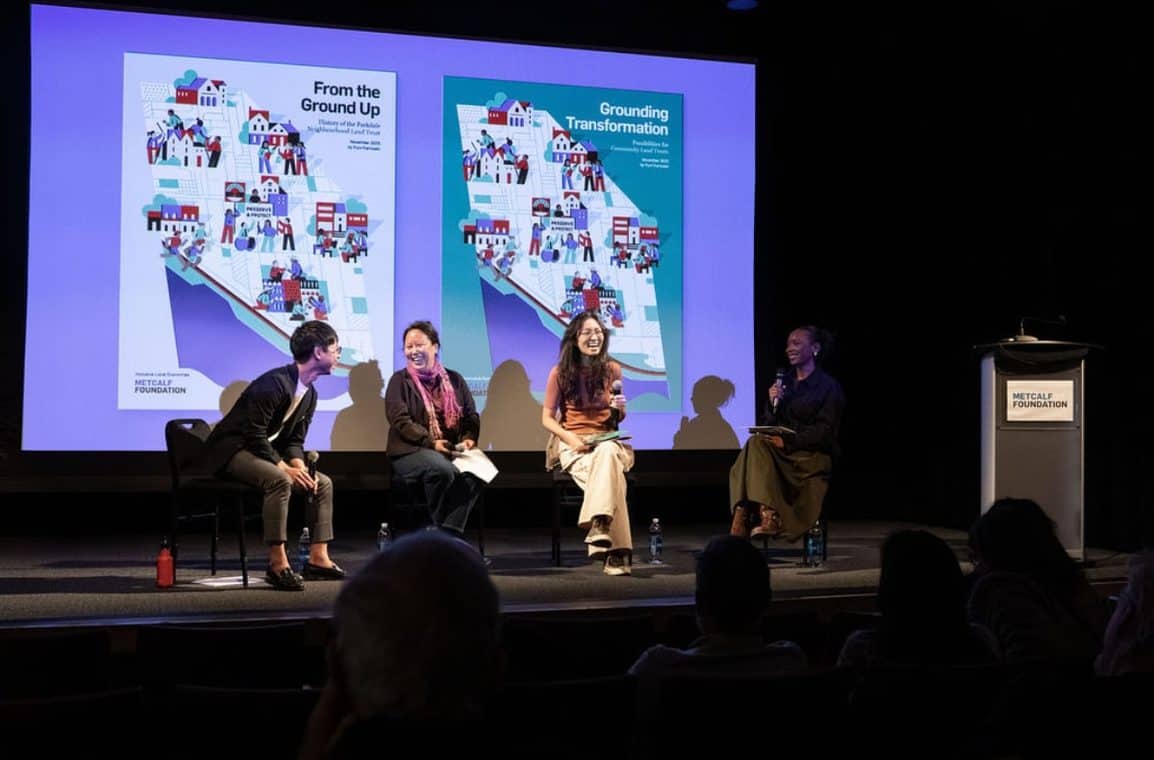
Recently through a Metcalf fellowship, Kuni Kamizaki, who helped catalyze the Parkdale Neighbourhood Land Trust, wrote a two-part report on its origins, evolution, and community land trusts’ potential for social transformation. At the end of From the Ground Up: History of the Parkdale Neighbourhood Land Trust, he shares a timeline of PNLT in which he layers the various historical and institutional conditions that PNLT grappled with as its strategy advanced and adapted. I love this table. It is grounded in the challenging questions that emerged in his interviews for the report, that many of us community development practitioners hold: “How (can) . . . we be accountable to community members who face immediate pressure of eviction and violence, when we talk about long-term strategies for equitable futures? What is to be done now in the face of immediate community needs without losing sight of long-term visions?”
It shows how the local is in relationship to the global, that systems and issues are embedded and interconnected, that community development and social action are iterative, both fast and slow, tethered to and tilled by socio-economic, political, and critical analysis. It shows how an ecosystem of ideas, leaders, and organizations (including philanthropy) collectively contributed to impact. Moreover, it reminds us that the structural forces – political, economic, cultural, ecological – shift and compound. Fissures create political opportunities that create openings for change. This work is not linear. We need to look for opportunities that are both possible in the moment and responsive to the future, straddling the horizons of short-term strategies and long-term goals.
We need to look for opportunities that are both possible in the moment and responsive to the future, straddling the horizons of short-term strategies and long-term goals.
This week, from September 28 to October 1, the Canadian Network of Community Land Trusts is holding its fourth annual summit in Ottawa. Each time I attend, I meet new communities that are strategizing to preserve and renew their vibrancy and affordability. I learn about bold, brave, and brilliant ways that organizations and individuals are challenging policies, offering system- and community-oriented solutions, and harnessing investments to preserve deeply affordable housing and maintain vibrant main streets. It is the conversations I value the most. The CLT movement is an incubator for a new wave of leadership that is inspiring, iconoclastic, innovative – and infectious. CLTs are collaborative and collective expressions of democratic decision-making. CLTs hold complexities and paradoxes. Deliberations focus on power, accountability, and capital. As Kamizaki asks in Grounding Transformation: Possibilities for Community Land Trusts, “How do we not replicate the problems that we came in to solve, such as evictions? [We are] grappling with complex identity issues from fighting landlords, to being a landlord.”
Paradigms are probed to centre stewardship and decolonize the relationship between property and land. This quote, from Michi Saagiig Nishnaabeg scholar Leanne Simpson in her book As We Have Always Done: Indigenous Freedom Through Radical Resistance, referenced in Kamizaki’s fellowship report, continues to provoke me, helping me understand what reconciliation is asking of us, and how community land trusts can respond: “The opposite of dispossession is not possession. It is deep reciprocal, consensual attachment.”
It is this critical analysis, this political subjectivity, Kamizaki posits, that completes the transformative potential of CLTs. A political self-actualization that is built through the collective pursuit of social justice and shared values. This resonates and echoes my experience of working with systems leaders in strategic philanthropy for the last 13 years.
Community land trusts are gaining momentum across Canada because they nourish the imagination, they “offer progressive reimaginings grounded in actual existing practices to push the boundaries of what we think is possible,” Kamizaki writes. If you find yourself disheartened about the pace of change, frustrated by fragmented responses, or you are seeking inspiration, rejuvenation, and collaboration on holistic solutions that are rooted in neighbourhoods, communities, and local leadership, learn about the Parkdale Neighbourhood Land Trust, support a local campaign, invest in a community bond, or find a CLT near you. The transformative potential awaits.