Creative pursuits outside of work like stand-up comedy or playing in a band might just be what your colleagues in the philanthropic sector need right now – to counter burnout, strengthen skills, or express their whole selves.
Lisa J. Smith, Indigenous engagement knowledge carrier at the National Indigenous Homelessness Council (NIHC), recalls a night in 2018 when, after a 10-year absence from doing stand-up comedy, she decided to enter a contest at Yuk Yuk’s in Ottawa. It was a big venue, she appeared alongside established comedians, and she had what might be described as a chip on her shoulder. It did not go well.
“Nobody laughed. I bombed,” she says. “I bombed very badly. And I know this sounds ridiculous, but that was one of the best moments of my life.”
Why such a surprising reaction? It has to do with burnout, the stealthy adversary that regularly derails careers in the philanthropic sector and hinders the ability of workers, especially women, to do their jobs to their full potential.
Raine Liliefeldt, director of member services and development at YWCA Canada, also battled burnout. Recently, she, too, began doing stand-up. Back in 2022, Liliefeldt had to step into the role of interim CEO (in addition to her roles as membership director and another vacant leadership position). “I was holding the most during that time,” she says. “In terms of stress and burnout, I didn’t even have the capacity to recognize that I was burnt out.”
For both Liliefeldt and Smith, comedy played a significant role in finding a path through burnout. They both came out the other side stronger emotionally and better equipped to do their day jobs. Exploring why reveals intriguing links between care work and creative work. It seems that staying true to what really matters can be a lot of fun.
“Burnout is real. Absolutely,” says Donna Brooks, CEO of YWCA Prince Albert in Saskatchewan. “It is tough to find that work–life balance.” Brooks knows that her staff deal with complex issues and tough situations every day. The YWCA focuses mainly on homelessness, abuse, and economic inequality among women and gender-diverse people. “People who come to us are usually having a crisis,” she says. “They’re not coming to us because everything is going well.”
Burnout is real . . . It is tough to find that work–life balance.
Donna Brooks, YWCA Prince Albert
The needs of their service users can feel overwhelming; the work is neverending. “We really can see in our staff, our managers, and our employees as a whole, the ones who have a good work–life balance because they thrive,” Brooks says. “They thrive with their wellness. And they still thrive when things go bad; they are able to deal with it. The ones who struggle with work–life balance, they’re the ones who don’t always thrive in those situations and are much more prone to burnout.”
Brooks’s organization has a number of supports in place to help people do their jobs well, like flexible hours, earned days off, and competitive compensation. But a critical component of their wellness strategy is acknowledging and encouraging outside interests. Brooks’s executive team puts all their extracurricular activities, from ju-jitsu training to gym workouts and music gigs, on a work calendar that’s shared with the entire management team. “It’s a very important part of what we do. It’s our wellness, and we know that wellness prevents burnout.”
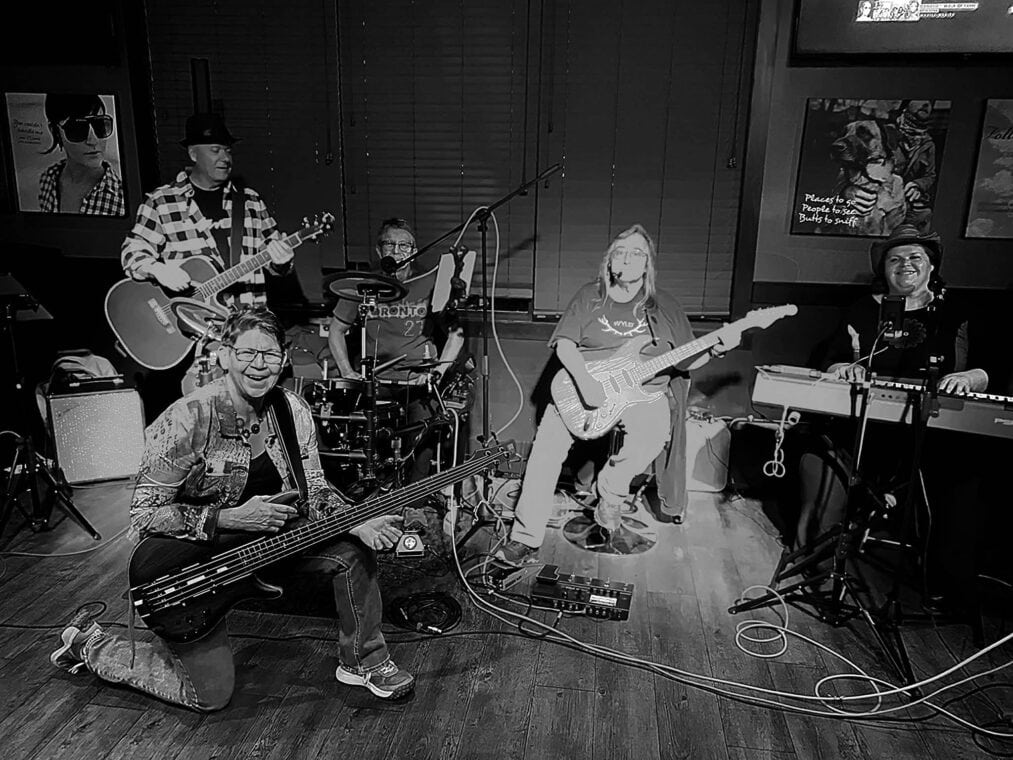
Brooks knows of what she speaks. In addition to running a $17-million organization with around 230 employees, she plays bass in a country/rock band. Her recently retired wife started the band three years ago, and Brooks wanted in on the action. Brooks had stopped playing hockey a few years prior – she is in the Prince Albert Sports Hall of Fame for her contributions to women’s hockey. Now, playing in a band is her team sport. “You’re connecting with your community. You’re connecting through joy. It’s not always the sad stuff.”
It may sound counterintuitive, but one of the best antidotes to burnout is more work. Side gigs, especially ones that involve audiences or interacting with the public, can be invaluable in addressing numerous issues plaguing workers in the sector.
All three women appreciate how their creative pursuits offer an escape from the grind of their day jobs. “I see our creativity as an outlet. It is stress relief,” Liliefeldt says. “It is where we are able to park our lives, our busy work lives, and be our other selves, be our high school self, or that person that isn’t responsible for everything and everyone.”
But expressive outlets aren’t just an escape. They can be proving grounds for skills and attributes that contribute to the day jobs: improving communication strategies, combatting feelings of inadequacy, and reinforcing authenticity.
***
Doing stand-up comedy wasn’t something new for Smith; it was a return – to the stage and to herself.
Growing up in Newfoundland’s Burin Peninsula, Smith had always been interested in comedy, performing routines for her parents and their friends. Her father and her grandfather both had reputations as storytellers and outrageous characters; she’s proud to take after them. At 19, Smith joined a musical theatre troupe. But, she says, “I couldn’t carry a tune in a bucket.” She recalls the director telling her, “‘You know what, Lisa? I don’t think it’s fair for people to pay to hear you sing. But how about you be you for five minutes?’ Now, had she said, ‘Do stand-up,’ I would have said no. But I can be me for five minutes. My god, I’ve been me my whole life.”
Once onstage, Smith realized what she was doing: standing in front of an audience telling jokes – stand-up comedy. “People really liked it. I was hooked. Hooked!”
Then she went away to law school in Vancouver. Like her Newfoundland accent, doing comedy didn’t fit her concept of what a lawyer should be. So both were packed away. In law school, she says, “they tear you down to build you back up. And in that process, I just sort of lost who I was.”
After school, Smith became a crown prosecutor in Gander, Newfoundland. The job was very exacting, very stressful, and very public. “I burned out really bad,” she says. “I went through an extreme depression. And so I said, ‘I need to get out of this profession.’” It was a heartbreaking decision – Smith had wanted to be a lawyer her whole life. But she pivoted. She moved to Ottawa and took a position with the Assembly of First Nations. “At the time, my friends were saying that I’d lost my light and my confidence. I was a shell of the person I was.”
Then came that fateful night at Yuk Yuk’s. “I was walking home, still shaking from being humiliated. And then there was this moment – I still remember it so clearly – it felt like I was 20 pounds lighter. It was this moment of ‘Oh, I don’t give a fuck what people think of me.’ The weight of other people’s opinions just totally evaporated.”
The stage is a safe place to fail, Smith notes. No lives were threatened that night; justice and jail time were not on the line. There is a camaraderie among comedians, known for their black humour and brutal honesty. It’s a unique community that taught Smith it was okay to fail as long as you get back up. “Everything I had gone through, the depression, just evaporated.”
Since she started doing stand-up regularly (as Lisa Jane) – almost monthly at first; now it’s more like four times a year – Smith’s career has gone from strength to strength. Now 40, she’s a much-sought-after human rights expert, both here and abroad. Her work with the Native Women’s Association of Canada, for example, played a significant role in Canada’s adoption and implementation of the United Nations Declaration on the Rights of Indigenous Peoples. “I found a place for humour in my work,” she says. “I’ve been to the United Nations. I’ve testified to the Australian Parliament and all over the world. And I use humour as a tactic for diplomacy.”
I found a place for humour in my work . . . I use humour as a tactic for diplomacy.
Lisa J. Smith, National Indigenous Homelessness Council
While Smith’s story is about a return to comedy, Liliefeldt never envisioned herself standing onstage telling jokes. She’s always been the scene-setter – like her volunteer work at a jazz festival in Toronto – not the scene-stealer. (Liliefeldt is also on the board of the Agora Foundation, which publishes The Philanthropist Journal.) For her, comedy is something very new, and it grew out of a growing understanding of how and why she does her best work.
In 2016, Liliefeldt was slated to give a talk on tech-facilitated gender-based violence at the Canadian Association of Chiefs of Police annual conference. The morning of her talk, she looked up online the location of what she assumed would be a small meeting room off to the side of the conference’s main events. Minutes away from giving her presentation, she realized she was scheduled to address a plenary session – all of the attending police chiefs and superintendents from across Canada would be there. “I freaked the fuck out,” Liliefeldt says. She called her father; she talked to her people; she calmed down enough to get into the conference hall.
When it was her turn to speak, Liliefeldt surveyed the room – and an arc of empty tables in front of the podium, the chiefs sitting farther back in the shadows. Liliefeldt, who in some of her comedy routines describes herself as a light-skinned Black woman and who stands five-foot-four, leaned toward the mic and said, “Yo, guys. There’s all these tables up front. Don’t be afraid of me.” The audience laughed, the room warmed, the chiefs moved forward and paid attention.
Liliefeldt says the response to her talk was great. As a result, she got connected to people across the country who could help move the work forward. “I realized that moment of being my own warm self and being funny – it just made the material more accessible,” she says.
I don’t know if I would have been able to get through some of the difficult parts [of my job] without having a creative outlet.
Raine Liliefeldt, YWCA Canada
It’s a talent Liliefeldt’s been honing over her nearly 14 years at the YWCA national office in Toronto. The YWCA is a federated organization. Its 29 member associations – like Smith’s in Prince Albert – collectively determine national policy and priorities. As membership director, Liliefeldt continually juggles and synthesizes some very strongly held opinions and perspectives, using a joke or personal anecdote to break the ice at meetings, make connections, and humanize situations and ideas. Liliefeldt doubled down on that talent during her tenure as interim CEO, a position requiring a great deal of public speaking. As usual, she would start events with a funny story before turning to the business at hand. “That became my favourite part of public speaking. It was so much fun. And then I started paying more attention to what I was going to write for that first minute than everything else,” she says. That’s when she started to write comedy bits for herself as comedy.
Then, in 2023, when handed the mic at a friend’s karaoke party, instead of singing, Liliefeldt did a set of her jokes. “People were in hysterics.” There was no turning back. She focused on her comedy writing and started taking classes and doing open-mic nights at clubs. When the YWCA named a new CEO, Liliefeldt’s workload became much more manageable. Her comedy gigs helped her reestablish a more sustainable work–life balance. At 54, she’s now very protective of that new and growing aspect of her life.
“Bringing levity to situations and people brought levity to me,” Liliefeldt says. “I don’t know if I would have been able to get through some of the difficult parts without having a creative outlet.”

For those who know Liliefeldt, the leap from the YWCA to stand-up comedy is not that surprising. What is surprising, however, is the many ways comedy affects her day job. All three women, in fact, talk passionately about how their creative outlets make their work – as well as their lives – better. All three see their side gigs as a way to connect to others and to their authentic selves.
In her public role, advocating for a shelter, for example, Brooks, 59, often comes up against strident opposition. But when she’s out in the bars playing with her band, those so-called opponents get to see another side of her, and vice versa.
“Being a big non-profit in a smaller city, everybody knows who you are, right?” Brooks says. “Even if they don’t know you, they know who you are because you’re in the news with controversial issues.” But playing in a band upends people’s preconceptions. “You’re seeing people from the community in a different setting, and they’re seeing you in a different setting. So you can have civil conversations with people,” she says. “Then it helps the day job because you’re making these connections playing music, and then [your opponents] are like, ‘Oh, she’s really not that bad.’”
Having outside interests also lets people see different sides of themselves, perhaps truer sides, more authentic.
“We all have imposter syndrome in this work,” Liliefeldt says. “It’s so big and real.” Sometimes it’s hard to remember all your assets and strengths. The answer, she feels, is to be grounded, and comedy keeps her grounded. “I want to be as authentic as possible. And for me, that authenticity is about showing up as myself.”
“The older I get, the less interested I am in putting on filters or censoring myself,” Liliefeldt says. “I’m amazed by some of the sentences that come out of my mouth these days – some of the funny things that I say, but also some of the real things that I say. And I think that one of the things that comedy has done for me in the last year is give me a kind of chutzpah that I never imagined myself to have.”
One of the things that comedy has done for me in the last year is give me a kind of chutzpah that I never imagined myself to have.
Raine Liliefeldt
For Smith, comedy is almost a form of therapy, a place where she can work through tough personal issues with the support of other comedians and the embrace of audiences. “The formula for comedy, in my view, is tragedy plus time,” she says. “When I’m uncomfortable in my own skin, that’s where I sort of lean in and depend on comedy.”
Both Smith and Liliefeldt see comedy contributing to their communication strategies at work because comedy demands clarity and it engenders empathy and deeper understanding.
“I think laughter is a universal language,” Smith says, “and that’s why I use it in diplomacy, especially in my role now, where I have to be a mediator.” Now based in St. John’s, Smith’s current work at the NIHC seeks to bridge the gaps of misunderstanding between government and Indigenous-led organizations tackling homelessness. Smith helps organizations secure funding by increasing their capacity around data collection. At the same time, she works to protect Indigenous sovereignty over that data. “The stress right now is making sure both parties trust me,” she says. “But I’m speaking different languages [to different groups of people]. What’s hard about it is that you’re forced to be vulnerable. You’re forced to be yourself. I’m leaning into that now, and that’s where humour plays a big part of it. I’ll tell a joke before I start a meeting, and that really helps foster positive relationships.”
“When I talk about an issue, when I talk about anything, I inject humour all the time,” Liliefeldt says. “I didn’t realize that it was a way for people to connect . . . Creating spaces for people to laugh together, or bringing laughter into those tense moments in our daily lives, that is how I care for people.”
Exploring why creative outlets like comedy or music can play such a transformative role for workers in the philanthropic sector goes right to the heart of why people work in the sector in the first place: that foundational impulse to help others in need. “Why care?” is like asking “Why create?” The response to both questions are flip sides of the same humanitarian coin. Care work is creative work; creativity is care. Life works better with both.