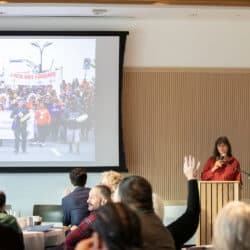
Women working in the charitable and non-profit sector are making sacrifices and building strategies to secure leadership positions despite barriers – or leaving altogether.
Nneka Allen spent more than 25 years working as a fundraiser in Canada’s philanthropic sector, founded the Black Canadian Fundraisers’ Collective, and is an award-winning author and co-editor of Collecting Courage: Joy, Pain, Freedom, Love – Anti-Black Racism in the Charitable Sector. Despite finishing Toronto Metropolitan University’s fundraising program, receiving her certified fundraising executive (CFRE) licence, and exceeding her fundraising targets, Allen never held a management position. Her experience is not unique.
Women in the non-profit sector earn 18% less than the average Canadian’s salary, compared to their male colleagues averaging 3% less. Women also occupy less than half of non-profit board director positions – not to mention racialized people being less than 10% of board director leaders, even though non-profit employees are more likely to be racialized. (There are insufficient data to demonstrate the disparity among 2SLGBTQIA+ leaders and women and gender-diverse leaders with disabilities.) Anecdotally, women working in the sector are dissatisfied with the barriers to leadership and inequitable working conditions the non-profit sector offers. The Philanthropist Journal spoke to women in the sector to learn about the sacrifices and strategies they employed to improve their bids for leadership.
Some of the women interviewed have chosen to remain anonymous for privacy and job security concerns; where that’s the case, a pseudonym followed by an asterisk has been used. When relevant and with their consent, some elements of their identities and job titles are included.
Using leadership skills to build community solidarity
Allen, who was a senior development officer and the only fundraiser on her team with a CFRE, met with her leader bimonthly, shared achievements with regular performance reviews, and asked for title changes and promotions – but was always declined. “I was by far one of the most experienced fundraisers across the foundation, but that was not reflected in title, and it certainly was not reflected in pay,” she says. It became clear she was not growing with the organization.
A frequent fundraising volunteer within her community, Allen decided to focus her skills outside of work. “I already know I’m a natural leader. I didn’t need them to validate that. But I wanted to be really specific about where I brought those leadership skills, and so I primarily brought them to the Black community.”
I was by far one of the most experienced fundraisers across the foundation, but that was not reflected in title, and it certainly was not reflected in pay.
While serving on the board of the Association of Fundraising Professionals, where Allen says she experienced racial discrimination before departing (and receiving an apology), she offered to coordinate a group of professional Black women fundraisers to gather insight and develop the organization’s strategic plan. The meeting was so successful that she was inspired to create the Black Canadian Fundraisers’ Collective (BCFC) to support Black fundraisers’ careers.
Allen says the demystification of how racism and misogynoir (race- and gender-based prejudice that Black women face) emerge often happens through storytelling, so creating proximity to share these stories is why “community becomes so critical.” BCFC members share how they are treated at work and which organizations they advise against joining. “If the work environment is not upholding or supporting our well-being, we should be looking to leave,” Allen says.
It’s what she did. Allen is now the principal and founder of The Empathy Agency Inc., a consultancy that offers individual, team, and fundraising coaching, alongside public speaking appearances. Seven years in, Allen says, “the most money I’ve ever made in my life, I’ve paid myself.”
Taking advantage of unions and mediators
Destiny* realized that her manager had stopped sharing her professional achievements with her director and team, including her conference speaking engagements and CFRE designation. Her manager also shared her medical information with a new colleague, commenting about how it affected her work output.
Destiny is a member of BCFC, so her fellow members helped her find a mediator to facilitate her workplace disputes. But she wasn’t the only one in need. “We’re bringing lawyers and workplace mediators in to guide people because a third of the collective is experiencing stuff like this right now,” she says.
During Destiny’s workplace meeting, the mediator and her management addressed divulging Destiny’s medical information, the lack of recognition within the organization, and the tone policing (criticizing the emotion behind how someone speaks, rather than what they are saying) she experienced. Destiny says her manager began tone policing her again soon afterwards. “It’s just so disheartening to be in an organization that is supposedly so progressive, and realizing that it’s [exactly the same as] an organization that’s known for being problematic to its staff.”
It’s just so disheartening to be in an organization that is supposedly so progressive, and realizing that it’s [exactly the same as] an organization that’s known for being problematic to its staff.
Destiny is a union member, so when she reported her manager’s actions, she says her representative validated that making comments about her medication information was not legal.
But not all charity and non-profit employees have a union to offer support. Canada’s biggest union, the Canadian Union of Public Employees, represents 54,700 members across 500 units, which include social services organizations. The non-profit sector employs more than 2.5 million workers.
“Most of the time, the organizations are breaking a severe amount of employment laws,” Destiny says. “They just don’t think that you’ll know what’s happening. Whenever something feels off, definitely document it. Put things in writing early on – who was there, when it happened, what was said, how you felt after, actions taken afterwards. All of that will help so much with an investigation.”
Oyeyinka Oyelowo, an Ontario-based civil litigation lawyer who specializes in labour and employment law, agrees. She says women should contact mentors or legal clinics for immediate advice on what to do after documenting the event, so they can build a case about the differential treatment they’ve received. “If it’s a woman of colour, if it’s a woman of colour with disability, if it’s a woman of colour with a particular religious background – all of those factors together actually make the damages much worse,” Oyelowo says.
For women without lawyers or unions, Oyelowo recommends reading any internal policies on discrimination their organizations have developed to comply with statutory law. She suggests that women familiarize themselves with regional legal codes, citing examples like the Ontario Human Rights Code, the Occupational Health and Safety Act, and the Employment Standards Act. “That knowledge will assist any woman that’s in a workplace where she’s experiencing gender discrimination to be able to immediately highlight to the employer the nature of how their behaviour is a violation of statutory law and jurisprudence.”
Destiny says senior leaders need more training on how to better manage Black women, employees with neurodiversity, and people with physical disabilities at work. She says it is “patronizing” to be described as “disrupting a healthy work environment” when she calls out microaggressions. “I can’t separate my identity from the work. I’m doing this to protect my family.”
According to data from the Building Movement Project’s report on women of colour in the non-profit sector in the United States, 49% of women and 54% of men of colour are more likely to work for identity-based organizations. For women working in organizations focused on people of colour or immigrants, 41% indicate that their race and ethnicity positively affected their career progression.
Destiny spent two years working as a philanthropy officer, responsible for external messaging, budgeting, event planning, advising senior leadership on legal matters, a portfolio of 1,400 donors and people making planned-giving inquiries, and teaching colleagues how to sign documents to avoid putting the organization at risk. She did not receive a promotion, despite seeing colleagues promoted within six months, which left her questioning her place in the sector. She credits BCFC’s support as she navigates her fears around career progression. “If it weren’t for the collective, I would leave the industry,” she says.
Refusing to treat work as ‘family’
As a leader, Alsana* was invited to the decision-making table but felt that her voice didn’t matter because decisions were still made without her. She led teams where she felt undermined and spoken down to by the employees she was responsible for supervising. As a racialized woman, she says there is additional pressure to support people’s emotional needs and be a perfect leader – an experience that her circle of racialized women leaders echoes. “Set the expectation that you’re not there to take care of everybody’s emotions,” she says. “You’re there as a leader of the organization.”
Alsana rejects the idea that organizations should see employees as family members. “It’s a trap, and I think women [and] women of colour are particularly targeted within that trap.” She says she celebrated the shift away from workplaces being treated as families. “I actually had a visceral response to it because it also implied for me that I had a caregiving role within that family.”
This can include emotional caregiving, like managing employees’ distress. Alsana says leaders and employees do not talk enough about the caregiving burdens women have at home. “We don’t actually recognize what that person has done just to be able to leave the house,” she says. “Daycare, drivers, pickups, activities, a senior who needs them, right? A lot of that disproportionately falls on women.”
Set the expectation that you’re not there to take care of everybody’s emotions. You’re there as a leader of the organization.
“I try not to take on the tasks that are typically around the caregiving of a team,” Alsana says. She does not organize lunches, which is an example of the low-status tasks women are more likely to volunteer for within the workplace, alongside event planning and committee work. Women ask men to do these types of tasks 26% of the time, while men ask other men to do these tasks 29% of the time. Half of the time, men accept. Women and men ask women to do these tasks 39% of the time. Women say yes 76% of the time.
Alsana’s focus is team cohesion, where she sets clear roles about how decisions will be made and each employee’s responsibilities. She says that non-profit boards also play a large role in how leadership is received and treated. “Boards absolutely determine the arc of leadership within an organization,” she says, because of how they treat leaders in board meetings and in front of staff. “There’s a lot of cues that everybody gets from [those] interactions.”
Alsana says that in addition to wage parity, boards need to ensure that their women leaders have the same access to learn and grow within the sector as men, which can be done, in part, by showing complete confidence and support of leadership in them. “When I think back on the most successful roles that I’ve had, most of it has been trust from people above me who just trusted my instincts, trusted my values, trusted my basic skills and expertise. They also trusted that if I didn’t know something, I would be open to learning about it.”
Challenging leaders and sharing wins so others can learn
Mina* was encouraged to accept a title change without a salary change. Initially, she says, her imposter syndrome kicked in because she thought she should just be grateful to get a promotion. On paper, her promotion was offered because her dedication and work proved she was ready for more responsibility around strategy and operations. But during meetings with her management she was told, “You need this title to be taken seriously.”
Mina did agree to the title change, but not without a salary raise to match. “I was not going to accept it unless I got compensated,” she said. “I will be honest, it was like pulling teeth, and it shouldn’t have been. But it was, and it took about six months for that to kick in.”
What’s needed to cultivate young leadership? What’s critical for organizations to understand when it comes to mentorship, to build the next generation of leaders?
Since then, Mina has found board leadership as another avenue for influence. She says she is grateful to serve on a social enterprise board, but she also wishes she had early career guidance to know these things, especially as a racialized woman. “What’s needed to cultivate young leadership? What’s critical for organizations to understand when it comes to mentorship, to build the next generation of leaders?” she asks. “Because I’ve always felt like a pawn. I always [got] people coffee or scheduled people’s meetings, and it was just not adding to any leadership I wanted to be part of.”
Mina says she was – and still is – often looped into emails by her male CEO to find time in his calendar for meetings with external stakeholders. She is annoyed by the assumption that she should take on the responsibility of a personal assistant while holding a director position. This experience, she has been told, happens frequently with other women leaders in the sector.
This is, in part, why Mina finds it empowering to talk about her career and measurable wins. She has participated in leadership and mentoring events online and in-person to speak about what equity in the non-profit sector could look like. “Taking space so I could make space for others,” Mina writes in an email, was her goal. “When it comes to the work I’m proud of, it is a lot of the partnerships I’ve made and the conferences I’ve been part of, to be able to talk about my experiences.”
‘Managing up’ and creating advocacy circles
Herleen Arora had trouble getting career-advancement support from senior leaders who weren’t Black or brown women.
Arora says that since leaders have a lot on their plate, they may not prioritize guiding their employees’ careers. She found a way around this by learning how to “manage up” at work. “You’d have to initiate. ‘Here’s my work plan. Here’s what I’m focusing on. Here’s what I’m forecasting next month. Here’s what I’m envisioning,’” she says. “You literally have to build your own work plan.”
That’s why Arora turns to social media to share her work. “There’s a notion that [racialized] workers need to work extra hard to prove and showcase that they’re worthy and they’re more than capable of doing these opportunities, even if they have credentials and the degrees, the skillsets on paper – you literally have to prove it.”
Arora says she has received project consultant opportunities from sharing her critical takes and equity work on LinkedIn and X – the clients did not have the internal knowledge or ways of thinking she demonstrated. One of her projects is the South Asian Women’s Collective (SAWC), an organization that supports South Asian women’s and gender-diverse people’s social and economic well-being across Canada through research, programming, and events.
You need people to advocate for you. If racialized women and folks are facing tensions in their workplace, automatically it’s really hard to get their reference from senior leaders.
Arora says that one workplace challenge is needing references to get roles. “You need people to advocate for you. If racialized women and folks are facing tensions in their workplace, automatically it’s really hard to get their reference from senior leaders.” She questions whether the practice is still necessary and chooses to prioritize providing the resources, access to conferences, and resumé support SAWC members may need. “I invest because I had such shitty investment in my own career development that [it] has become a number-one value and a focus for me when I work with many other staff members on my team.”
For Surabhi Jain, co-founder and facilitator of the women’s leadership program Women in Power, her priority is helping women interrogate their lived experiences so they can build inclusive leadership practices at work.
Jain, who left previous non-profit roles because of racism, harassment, and job stagnation, says each Women in Power cohort reaches a moment of reckoning where they admit that their response to being oppressed in the workplace is continually trying to make white men or white women leaders happy. “It is Black and brown women trying to keep white women happy, who are trying to keep white men happy, and that’s because white men are the gatekeepers to white women. White women are the gatekeepers to Black and brown women.”
Women in Power’s emergence program helps women recognize systemic inequities that affect career growth and provides self-advocacy resources. The foundation program allows leaders to hear about others’ lived experiences and develop frameworks to become inclusive leaders. The elevation program focuses on strategic communication to advocate for others and challenge systems that stifle women’s professional growth.
Jain says employees are constantly people-pleasing at work, depending on who is holding the purse strings. “I think women in non-profits end up giving more of their blood, sweat, [and] tears than needs to be, and it is neither recognized nor appreciated,” she says. “I think we just need to be mindful of how much energy we put into it.”
Avoiding burnout in the career race
According to Future of Good’s Changemaker Wellbeing Index report, one third of non-profit workers feel burned out and exhausted most of the time, while 70% feel it some of the time.
Hailey Rodgers, the executive director of the Women’s Nonprofit Network (WNN), observed this trend in the women she’s volunteered with over the past eight years. She launched WNN in 2024 to help women connect and advance within the sector. She volunteers 10 to 15 hours a week to lead WNN alongside her full-time job, which is outside the non-profit sector.
Last International Women’s Day, WNN published its “Confessions of Women in Nonprofits,” outlining the harsh reality women face and advice for others working in the sector. Its August Pulse Check Survey revealed women continually facing financial inequity, barriers to leadership advancement, challenges from having intersecting marginalized identities, and burnout from unsustainable working conditions.
Rodgers and her team previously curated a list of WNN’s followers, combing through their LinkedIn profiles to find work achievements to celebrate on WNN’s platforms. “It was so interesting how such a small little recognition could make such a positive impact on someone,” Rodgers says.
WNN expanded this practice with its inaugural Women’s Nonprofit Network Awards on October 21. The awards celebrated “Breakthrough”; “Visionary Impact”; “WNN Volunteer of the Year”; “Legacy of Equity”; “Empowerment & Connection”; “Diversity, Equity, Inclusion & Belonging”; “Transformative Leadership”; “Corporate Trailblazer”; and “Workplace Wellness.”
“If you’re not pausing and looking inward at the people who are doing the work to support these communities, how are you absolutely optimizing these resources?” Rodgers asks.
October 21 also marked the launch of Women in Nonprofit Awareness Day, which aims to recognize women’s dedication to creating meaningful change in their communities and “mobilize nonprofits and the public to recognize undervalued work, while building a national network of champions,” according to WNN’s website. “It’s time Canada knows the women powering our non-profit sector.”
*Name has been changed.