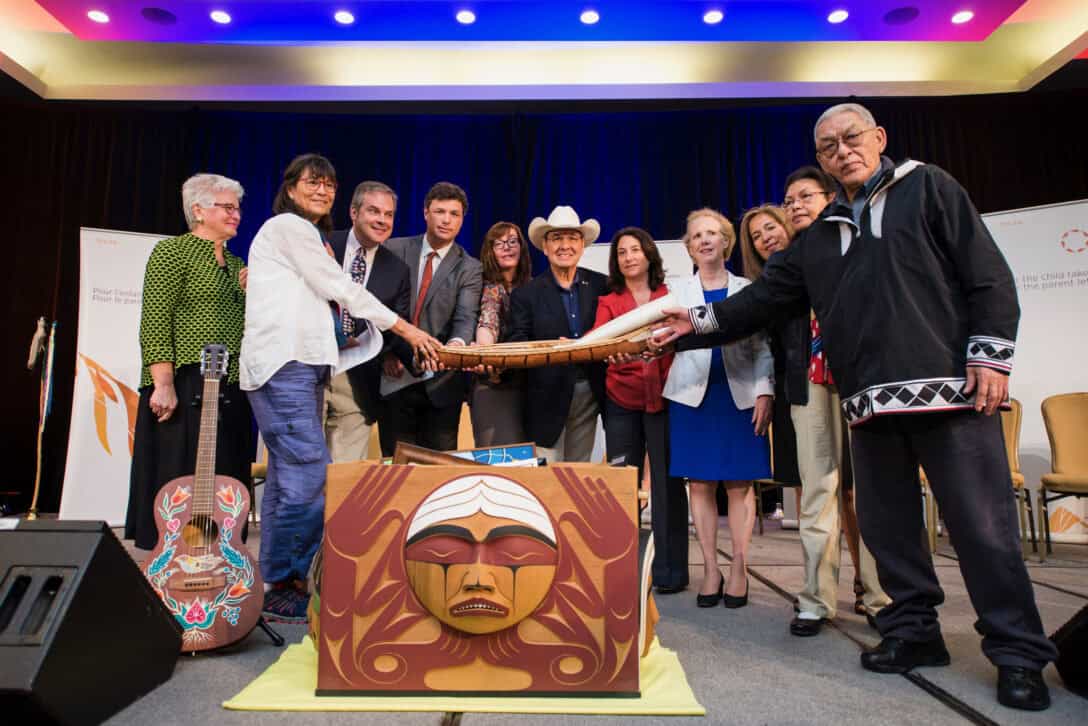
In 2015, the Canadian philanthropic community made a “pledge to do better” on reconciliation. At an event marking the 10th anniversary of the Declaration of Action, Indigenous-led charitable foundations took centre stage.
Speaking to a room of about 50 people last November, Josh Iserhoff introduced a Cree word to his audience, inviting the group to pronounce the syllables for themselves: “Dehshibiidaakin.”
What does it mean?
“In our Cree Nation, a dehshibiidaakin is something so ordinary you might miss its power,” Iserhoff said. It’s a cache for storing food, he explained, one that’s built out on the land in a place where a family might “store what’s needed for whoever comes next.” You take what you need from the cache. But before you leave, you fill it again with whatever you can. “It’s not about ownership,” Iserhoff said. “It’s about responsibility. It’s about trust. It’s about being certain that someone before you cared enough to prepare the way.”
Iserhoff is the manager of partnerships and community at the Indigenous Peoples Resilience Fund (IPRF), an Indigenous-led fund serving Indigenous communities across the country. The IPRF was founded in the early days of the pandemic as leaders realized that Indigenous communities would be disproportionately affected by the crisis but might not get the support they needed because of long-standing systemic barriers that make it hard for Indigenous people to access funding systems that “were not built for our realities,” Iserhoff explained.
Now, the IPRF has evolved from being a pandemic response to making more long-term investments in the well-being of Indigenous communities. Last year, it distributed almost $2 million to grant recipients – including both qualified and non-qualified donees. Iserhoff conjured the image of the Cree food cache when describing the IPRF’s work. “That’s exactly what we’ve built together,” he said. “A dehshibiidaakin for our people.”
Iserhoff was speaking at the Canadian Canoe Museum in Peterborough, Ontario, where philanthropy professionals gathered in November for a one-day symposium to mark the 10th anniversary of The Philanthropic Community’s Declaration of Action in support of Indigenous communities. Drafted and signed in 2015, the Declaration of Action coincided with the release of the Truth and Reconciliation Commission of Canada’s final report. At the time, the declaration expressed a commitment from more than two dozen Canadian philanthropic organizations to use their resources to advance reconciliation. Since then, scores more organizations have come on board, bringing the total number of signatories to more than 100.
‘A pledge to do better’ from the philanthropic sector
Bruce Lawson, former CEO of The Counselling Foundation of Canada, was in the room when The Philanthropic Community’s Declaration of Action was drafted in 2015, and he was in the room to mark its 10th anniversary, as well.
He says that while the TRC’s 94 Calls to Action largely focused on actions that governments and public institutions must take to advance reconciliation, there was a growing sense in philanthropic circles that the charitable and non-profit sector had a role to play as well, as the TRC prepared its final report.
Research published by The Circle on Philanthropy in 2014 had suggested that only 1% of charitable organizations in Canada served Indigenous communities, and those that did tended to have lower fundraising revenues and received, on average, smaller grants than charitable organizations that served non-Indigenous communities.
“‘Aboriginal’ and ‘philanthropy’ are not words that come together often in Canada,” another report from The Circle stated around that time. “We want to change that.”
Lawson recalls that at least two of the TRC’s commissioners, Murray Sinclair and Marie Wilson, had themselves signalled a desire for Canada’s philanthropic community to make a commitment of its own upon the release of the TRC’s final report, a commitment that was “action-oriented [and not] just another piece of paper,” Lawson remembers.
So a committee was struck, and the Declaration of Action, which includes commitments for the philanthropic sector to learn, understand, and act in light of the TRC’s findings, was drafted and finalized. Essentially, the document was “a pledge to do better,” Lawson says.
Making philanthropy more accessible to Indigenous communities
During the morning session of November’s symposium in Peterborough, attendees heard short talks from six Indigenous leaders who are working in the philanthropic sector to directly support Indigenous communities.
One key to success, according to Udlu Hanson, is building philanthropic processes that reflect the ethic of generosity that already exists in Indigenous cultures. Hanson is a founding member of the Annauma Community Foundation, the first community foundation in Nunavut. Like the IPRF, Annauma was founded during the COVID-19 pandemic.
Hanson told attendees that in Annauma’s early days, supporters from southern Canada offered various policies and governance models that had worked for them but which the Annauma team didn’t think were a fit for Inuit communities. The fledgling foundation “had to look like our community,” she said. “It had to look Inuit.”
Philanthropy is sharing . . . It was instinctive growing up.
Udlu Hanson, Annauma Community Foundation
In the North, communities already practise philanthropy; they might just call it by a different name. “Philanthropy is sharing,” Hanson said. “It was instinctive growing up. We knew how to share. But how do we do that in the modern sense, in a way where we’re still accountable . . . to [the Canada Revenue Agency and] to our funders in the South?”
Annauma’s answer is to empower community members with decision-making authority and trust them to allocate funds in a way that lifts all boats, Hanson explained. The foundation uses a consensus granting process that “places decision-making power over project activities, funding allocations, and final reporting metrics to those who participate,” according to a guide shared on the organization’s website. “Inuit communities and community members have always depended on one another for food, security and societal strength,” the guide states. Rooting Annauma’s processes in those traditional values helps to make the organization’s work feel more familiar to the Inuit people the foundation serves.
Fostering consensus decision-making isn’t the only way to make granting processes more accessible to Indigenous communities. Lawson points to the IPRF’s willingness to accept oral grant applications in addition to written ones as another example. “It’s fantastic,” he says of the practice, “and it honours the old oral tradition.”
Brian Jackson, the McConnell Foundation’s reconciliation program director, adds that allowing gifts to non-qualified donees is another move in the right direction. “There are many Indigenous organizations that don’t have charitable status in this country,” says Jackson, who also serves on the board of directors of the IPRF. Requiring charitable status shuts the door on many of those organizations, but changes made to the Income Tax Act in 2022 give foundations more flexibility to support grassroots organizations that aren’t charities.
Sector needs to adopt accountability measures
Lawson says he left the gathering feeling “really positive.” While he doesn’t believe the philanthropic community has “reached the promised land” of reconciliation – there is a lot more work to do – he does believe the sector has made strides over the last decade. “Relationships are being built. Capital is being deployed,” he says. “Voices that were previously ignored or silenced are being listened to.”
Relationships are being built. Capital is being deployed. Voices that were previously ignored or silenced are being listened to.
Bruce Lawson, formerly The Counselling Foundation
But he also notes a lack of hard data to back up the belief that the Declaration of Action has had an impact. Because it was drafted in haste, with the goal of winning over as many signatories as possible, the declaration didn’t include concrete commitments or actionable mechanisms for measuring success. In short, “we didn’t build in accountability,” Lawson says.
That could be work for the Declaration of Action’s next decade. During the symposium’s afternoon sessions, attendees broke into smaller groups to brainstorm what the declaration might accomplish in the future, and discussion prompts shared with each table included topics that lent themselves toward the development of concrete, measurable goals. For example: How can we ensure that more Indigenous people hold leadership positions at Canadian charitable foundations? Or, how can we ensure that more philanthropic capital is directed to Indigenous-led organizations in the future?
Those prompts seemed to strike a nerve for at least one discussion group. Jennifer Debues, the executive director of the Community Foundation of Greater Peterborough, said accountability and transparency were key topics discussed at her table during the afternoon session.
But building in accountability will require effort – and funding. Lawson says he’d like to see research funding made available so the philanthropic sector can do a better job of measuring its progress on reconciliation. Otherwise, he notes, there is a risk that the Declaration of Action becomes just another broken treaty.
Indigenous-led philanthropy is gaining momentum
Speaking to the audience, Karen Joyner-Blom described herself as “a rookie” in the philanthropic sector as she talked about her work at the Eenou-Eeyou Community Foundation, where she is the director of communications and community outreach. Joyner-Blom, whose home community is the Cree Nation of Chisasibi, said she looks to the work of her Indigenous peers in the sector – many of whom were in the room that day – for inspiration and guidance as she navigates the “steep learning curve” of her new job, which she’s held for about a year and a half. “There’s so much ground that’s been laid out, which I’m very grateful for as someone who’s new in this field,” she said.
The emergence of a new cohort of Indigenous philanthropy professionals is itself a sign that the Declaration of Action has had an impact, Lawson says. Ten years ago, it might have been tricky to fill a panel with representatives from Indigenous-led charitable foundations in Canada. But in 2025, it was easy, and the speakers in Peterborough offered proof that the sector is transforming itself. “The proliferation of Indigenous Peoples who are working in the philanthropic sector has really blossomed,” Lawson says.
Philanthropy has to be really careful in terms of not over-promising and under-delivering.
Brian Jackson, McConnell Foundation
To Jackson, the 10th anniversary event was a reflection of the “growing momentum” and “deep sense of possibility” that is pushing the Indigenous-led philanthropic movement forward. But he encourages those working toward reconciliation in the philanthropic sector to heed a warning that was shared at the event: “Philanthropy has to be really careful in terms of not over-promising and under-delivering,” he says. “It’s better to start small and to grow bigger as trust emerges.”
Jackson says he sometimes feels a tension between the urgency of the challenges facing Indigenous communities and the pace of change, which can sometimes feel too slow. But then he returns to the teachings of his Anishinaabe tradition, which remind him to think of and care for the next seven generations. “The intention is an intergenerational one, and so the timescale is actually quite large,” he says. And this is where philanthropy has a particular role to play in the journey toward reconciliation. The sector has an opportunity to “get at the root of issues . . . in ways that some of the other sectors may not be able to,” Jackson says. Philanthropy can afford to be patient, eschewing the “quick wins” that other sectors might prioritize and instead engaging in the slow but meaningful work of building stronger, healthier communities at the grassroots level.
At the centre of those efforts, Jackson reminds us, there will always be relationships. “We need to move at the speed of trust,” he says.