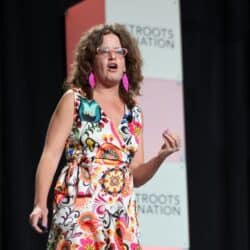
In an exclusive interview with Christina Palassio, Anand Giridharadas, whose latest book is The Persuaders, talks about building progressive fronts, crafting popular narratives that unite instead of divide, and crossing political lines to connect with people on a values level.
In the prologue to his fourth book, The Persuaders, Anand Giridharadas describes how the Internet Research Agency, a Russian industrial troll farm, used fake social profiles to sow disinformation, inflame mistrust, and undermine trust in democracy in the United States. It’s a deeply upsetting case study of how hate spreads faster than facts.
The Persuaders begins by pulling back the curtain on how bad actors use the power of social media to spread lies and hate, but the mission of the book isn’t to depress readers. While his previous book, Winners Take All, described how the wealthy elite distract us with the illusion of change while they continue to amass enormous wealth and power, The Persuaders is a study of the individuals and movements that are fighting against hate and for real progressive social change – by building progressive fronts, crafting popular narratives that unite instead of divide, having difficult conversations, and refusing to participate in what he calls “the great write-off.”
Giridharadas spoke with The Philanthropist Journal in Toronto in late March at the 2023 DemocracyXChange Summit, where he delivered the opening keynote.
You say you want the pro-democracy side to reclaim persuasion but that progressives have lost the ability to talk about democracy in ways that are truly compelling. Why is that? How can we persuade people that democracy is worth fighting for and participating in?
If you’re in the business of selling hatred, xenophobia, tribal nationalism, and a nostalgic misogyny for the old days, you inevitably get good at speaking to people’s hearts – in part because you offer nothing to the head. You’re selling lies, you’re selling fraud, you’re selling false demons. And so you get very skilled, as neo-fascist movements around the world are now, at speaking to people’s hearts and rousing people and getting the blood up, as my colleague Roger Cohen said recently.
One of the challenges that I see, and that motivated The Persuaders, is that as pro-democracy movements around the world try to counter this rising tide, many of them are stuck in this mode of appealing only to the head: facts, data, science, policies, earnestness. It comes from a good place and a good impulse. In fact, it’s precisely because the other side has abandoned the terrain of reality, of the head, and of science that one feels compelled, on the pro-democracy side, to be smart and sober and rational. Yet a big fear I have is that we’ve conceded the terrain of emotion, of psychology, and of anxiety that is, whether we like it or not, the battlefield on which big politics is being fought right now. And we’re handing the future over to very dangerous movements because they know how to speak to people where they are, while we, on the pro-democracy side, are often speaking to people as we wish they were.
Where are people at right now?
The reason the battlefield is especially an emotional and psychological one right now is that we’re living in an age of extraordinary upheaval in people’s self-conception.
We talk about forces: Big Tech, the rise of China, the recession of democracy, globalization, the empowerment of women, the rise of LGBTQ rights. As someone who writes about the way individuals experience change, I look at these forces as really big upheavals in how many people see themselves as part of a whole. People are asking themselves, “Who am I? Do I belong here? Am I going to be okay? Am I a good person?” These are the basic visceral questions that people actually spend their days thinking about, as opposed to “What’s the right tax rate?” or “What’s the right immigration policy?” The actual questions that animate all of our days are “Am I okay? Am I good? Am I decent? Are my kids going to respect me? Am I on the right side of history?”
We live in an age in which big forces have destabilized so many people. Not just white folks, not just men – although straight, cis white men are on the headwind side of a lot of those changes. But in general, there’s this revolution of people’s sense of where they fit in. Neo-fascist movements have understood this and have built an entire politics to sit on top of these anxieties that they have quite astutely understood are roiling societies. And pro-democracy folks, although they mean well and have actual policies designed to get people retrained if their job went to China, or to regulate Facebook, or to deal with the fact that more women are working now than 50 years ago and we need daycare – the pro-democracy side has done all these right things but has failed to recognize and cater to the big feelings that are tossing society one way or another.
That was my motivating factor in writing The Persuaders. I want the pro-democracy movement to be able to rise to the challenge of speaking to societies awash in anxiety as compellingly, if not more compellingly, than movements of hatred, nostalgia, and antipathy.
How do language and framing help or hinder social change? In Winners Take All, you point out the problems that emerge when we reframe issues to make them more palatable to an audience. In The Persuaders, you revisit the idea of framing, this time profiling people who use framing tactics as a way to cross political lines and connect with people on a values level.
In Winners Take All, my concern was about reframing inequality as “creating opportunity” when you’re talking to powerful audiences and basically clipping the wings of an idea to get funding.
I encourage that kind of reframing in The Persuaders, but it’s very different. I think sometimes the left takes really worthy, righteous struggles and speaks about them in ways that marginalize them and exoticize them rather than emphasizing how mainstream and sensible they are. It’s partly out of the generative part of identity politics that wants to see each struggle in its particularity and in its uniqueness. But there’s a way in which we sometimes allow, for example, a fight for trans rights to be pigeonholed into some niche fight, when I want to talk about it in the language of bravery and freedom. Who’s braver than a 14-year-old trans kid from a small town in Canada who’s receiving no support from their immediate community to be who they know they are, and who persists in being that person anyway? That is braver than any soldier I know. That is a more courageous stand for freedom than someone who has a freedom bumper sticker on the back of their pickup truck.
I think sometimes the left takes really worthy, righteous struggles and speaks about them in ways that marginalize them and exoticize them rather than emphasizing how mainstream and sensible they are.
Anand Giridharadas
How come, in the array of things we’re saying about trans rights, we’re not strumming chords about freedom and bravery and courage? Chords that might speak to some of the people who are not yet organized or converted on that issue. We already have the people who think about human rights and believe we should stand up for marginalized people. We’re trying to get the next 10% and the next 10% after that. That’s when we’re going to get some safety. A lot of those people may not be excited about extending rights to more marginalized people. But they’d love a good story about bravery and the pursuit of freedom.
Similarly, after the horrendous attack on abortion freedom in the United States, there was a state referendum in Kansas in which the question was basically whether a state constitutional protection of abortion would stand or be taken down. Kansas is a deeply libertarian, right-leaning place that has, by the way, pretty significant support for abortion rights. Campaigners ran a cynically brilliant campaign – I don’t say cynical in a bad way here – with ads that obliquely compared the government’s effort to compel forced pregnancies to the government’s efforts to compel mask-wearing. Now, the women who led that campaign supported mask mandates. But that doesn’t matter. They were trying to appeal to a group of people who didn’t like the mask mandates. And they were reminding them that y’all didn’t like when the government came around a couple years ago telling you what to do with your body, and now the government’s coming back around – they didn’t even mention abortion in some of these ads – and trying to tell you what to do with your body again. And Kansans are not going to stand for it.
That’s the kind of brilliant politics that I’m interested in, and that the pro-democracy movement doesn’t do often enough. To me, it’s not selling out. It’s recognizing that the right to abortion is not only a feminist issue – although of course it is a feminist issue – it’s an issue for those who are concerned about individual rights and freedoms. If you’re concerned about family values and families getting to make the best choices for themselves, this issue is for you.
I’d like to see the pro-democracy movement get a little more promiscuous with frames and understand that we’re not compromising ourselves when we explain to our range of voters the ways in which our deepest values resonate with some of their deepest values – even if we don’t share those values with them.
In the Kansas case, did the campaigners do themselves a disservice when they perpetuated the idea that abortion as healthcare is an individual concern instead of a right that should be fought for and enjoyed by all?
I don’t think the idea of abortion as freedom from government overreach is a small frame. I think that’s a pretty big idea. To me, it feels like an idea that grows out of a deep understanding of where America is – as opposed to where you wish it was. Human rights is not a mass selling point in the United States. Helping women, sadly, may not be the mass selling point in the state of Kansas that one hopes it would be. But having the government not tell your family what to do is a really effective frame. And to not be willing to use that is a missed opportunity.
Now, there are some frames you don’t want to step into because it’s bad territory for you. I talk about that in the chapter in the book on [the communications consultant] Anat Shenker-Osorio. If you’re on the left, I don’t think you want to get into a debate on who’s better for business or who’s tougher on crime because that’s not your terrain. You can’t win. I think you can compete on who will keep you safer. But I don’t think you can compete on who’s tougher on crime because you validate a worldview that you actually don’t want to build up. But things like freedom, things like God: these are uncontested political greenfields, and I think the pro-democracy movement makes a mistake by treating them as fully owned territories by the right.
What’s the role of non-profits and charities in rebuilding democracy and trust? How can the third sector support the transition out of the age of the great write-off?
In the United States, there’s been a 40-year concerted assault on the idea of government and government provision. Government has pulled back, and philanthropy and non-profits have filled a lot of that space. It’s happened everywhere, but in the United States it’s very pronounced.
Winners Take All dealt with the problems and contradictions of that void-filling. What I advocated for in that book and beyond is not for there to be no non-profit sector or no philanthropy sector, but for those sectors to think about the work they do in ways that would tend toward greater systemic change, and to not operate and function in ways that actually further sap public purpose and public capacity.
I really encourage, to the extent that we have big philanthropic money and non-profits out there working, encourage them to work in ways that would tend to work towards greater public capacity and system-level change.
There are ways to structure what non-profits and philanthropists do that are fundamentally diversionary from government and used to undermine the idea of government. And then there’s other ways. For example, when foundations invest in training people from underserved communities to be more effectively able to run for office, that’s really different from running your own meal-distribution program, which is something government should probably be doing. In the training case, you’re trying to create conditions in which you wouldn’t have to do something like the meal program because you’d change who’s in government over the next generation.
I really encourage, to the extent that we have big philanthropic money and non-profits out there working, encourage them to work in ways that would tend to work towards greater public capacity and system-level change.
How do you view the shift toward trust-based philanthropy?
I think there’s been a real shift in the discourse of philanthropy around recognizing and seeing its own power without illusion. It’s very hard for there to be perfect giving or perfect change from these spaces. But when you see someone like MacKenzie Scott giving away money in ways that seem less interested in asserting ongoing control, and that do not require non-profits to constantly be jumping through hoops to apply, it feels like a message is getting through to certain people.
When you see someone like MacKenzie Scott giving away money in ways … that do not require non-profits to constantly be jumping through hoops to apply, it feels like a message is getting through to certain people.
I think there are still more of the old-school types than there are MacKenzie Scotts. But I feel there’s a kind of internal schism around the question of are we an imperious, fundamentally colonial sector, or are we able to be part of the shift to an increasingly democratic open world? And I think more and more people who work in non-profits and big philanthropies are interested in being part of the latter, even if it’s hard to move their institutions as a whole.
You and many of the persuaders you profile in the book – Linda Sarsour, Loretta Ross, Anat Shenker-Osorio – advocate for building popular fronts and shifting from call-out culture to call-in culture. How can non-profit leaders contribute to building united fronts?
First of all, I will say that I think a lot of the reason we have internal turmoil and reckoning within organizations on the left or within the movements of the pro-democracy cause at large – a lot of that comes from a good place. The left is not a cult. The right is increasingly a cult in many places. The left fights because the left is free and a lot more people have been included in the last generation. We now know what a lot of women think, which was not openly expressed 50 years ago. And we know what a lot of Black people think about what it feels to work in all kinds of spaces that we didn’t know 50 years ago. That’s good.
The fact that people are speaking up, not putting up with things, and complaining about harassment and blind spots is good. And it has absolutely increased the level of turmoil and inner conflict and calling out. I’m not on the side of stop all the calling out, shut it all down, everybody be quiet, we need to just band together and beat the fascists. I really think that’s a very problematic stand. At the same time, I think you need to be able, as a healthy adult movement, to have those conversations and reckonings and face those questions and also go out into the world as a popular front and hang together with a certain kind of spirit of suspending those beefs and resentments – not shutting them down or eliminating them or pretending they don’t exist, but suspending them and being able to understand that there are moments for moderates, progressives, radicals, leftists, centrist moments to stand together, bite their tongues a little bit, and enact big things and resist dangerous leaders. And there are moments to have really big, meaningful, generative fights about these issues.
You recently interviewed the author Maggie Nelson, and one of the questions you discussed is why we aren’t more excited about addressing the climate crisis – or, as you say, building a world where our kids can drink the water and live healthy lives. You could ask the same question about building a stronger democracy. We have this opportunity to build a stronger social contract, but instead of it feeling exciting, it feels like a chore. Can we flip the script?
Think about the biggest-grossing movies people watch. They’re not about people laying on a beach. They’re about people daring impossible quests with lots of obstacles and triumphing in the end. Think about the video games people are addicted to. They’re not about people playing the piano gently. They’re about fighting, swatting off dangers, and prevailing.
The fight for climate, the fight for an earth that’s healthy and where we can be healthy, seems to me an inherently thrilling quest, in the tradition of the kind of action movies we like and video games we’re drawn to. But somehow, through our own fault, it’s gotten slotted in the lane of Lent-like deprivation. Like, we’re all going to just have to get sad and sacrificial. It’s like the intermittent fasting of the planet. It’s just sad and low blood sugar and a downer. There’s a lot of reasons for that. It is a pretty dire timeline. So it’s not insane that it’s come to be associated with some of those feelings. But we know from all kinds of political and social science research that those kinds of feelings are demoralizing. They make people go into their shell. They make people stay home. They make people watch reality TV and think nothing can be done. They make them stop answering political emails. They make them not go to meetings in their communities.
I don’t think we can depress the hell out of people as the way to save the world. I don’t think we can tell people whose lives are already hard that they’re going to have to sacrifice to save the world. They may in fact have to sacrifice to save the world, but I don’t think that can be what we’re leading with. I think we have to tell them they’re going to get some amazing types of electric cars that are so fun and so cool. I think we need to tell them they’re going to love their electricity bills in the future. I think we have to tell people stories about collective undertakings.
I don’t think we can depress the hell out of people as the way to save the world.
We all can think about older relatives who lived through really hard times and weirdly had positive feelings associated with those challenges. It meant something. It mattered to be on the home front in World War II and do the work that you did. It mattered to fight a war in Europe. It mattered to be part of a Great Depression generation where, yes, you survived great hardship, and that led to the creation of the kinds of common institutions that are now the foundation of democracies around the world.
I encourage all of us who want to live on a clean, healthy, safe planet to drop the downness, drop the sacrifice thing. Do not hand the right this easy thing of saying, “They’re trying to take away your TV, they’re trying to take away your car, they’re trying to take away your gas.” Offer people a really exciting invitation into a thrilling collective project. Let’s have our kids coming home from science class full of ideas. Let’s all be on it and saying, “We’re gonna do this thing!” The kids are thinking about it at school, the adults are dealing with it at work, like the politicians are dealing with it, and we’re all figuring this thing out.
I think one of the myths in politics is that people just want an easy life. To go back to the point about movies and video games: I think people actually like struggle. People like feeling like part of a quest. But we haven’t invited people into a quest. We’ve told them we need to tax them. We’ve told them they have to stop doing things. I would drop all of that and invite people into this awesome project to save the world and become the first human generation to live properly in balance with nature and each other.
In our time, we have a chance to build human communities that have a knowledgeable, harmonious relationship with nature. And there are non-climate-related problems that we can solve in tandem. In the United States, the transit landscape is shaped by racism. We didn’t build transit infrastructure in cities like Detroit because it was largely a Black city after white flight. To get to the climate numbers, we’re going to have to build transit in cities like Detroit, so we’re going to have to fix things that, frankly, we would not have fixed without climate change. Climate change affords us an opportunity to look at deep, large-scale social reform in a way that wouldn’t have been possible if we didn’t have this massive quest ahead of us.
What’s the electric car of the democracy-building movement?
I think it’s different in different places. In the United States and in Canada, we’re not just trying to defend a pre-existing, static idea of democracy. We’re actually trying to build a new kind of democracy that has not really existed in history, which is a multiracial democracy.
People always love Norway and these nice Scandinavian countries. No offence to those places, but it’s easy to do strong-safety-net democracy when everybody looks like a third or fourth cousin of each other, there’s not a lot of diversity, and there’s a pretty common history. These are not nations of immigrants. They have quite small populations.
I’d love for more of our leaders on the pro-democracy side to invite people into this quest to build these democracies made of the world, democracies that are self-confident enough to bring all kinds of people into them and make them good contributing citizens.
What Canada and the United States are trying to do is a lot harder. And if we’re being honest with ourselves, among friends, it’s not even clear that it’s a workable project. There are not a lot of models in history of countries that essentially took people from all over the world and tried to create an invented composite identity made of the desire to come to that country, or the desire to make good in that country, or the desire to seek something that you couldn’t find somewhere else.
I’d love for more of our leaders on the pro-democracy side to invite people into this quest to build these democracies made of the world, democracies that are self-confident enough to bring all kinds of people into them and make them good contributing citizens. And to expose the small-heartedness of our opponents. We sometimes build them up as being these big powerful, vicious people. But they’re kind of like small-hearted nincompoops. Their only idea is to stop the march toward a bigger “we.” That’s not a particularly compelling idea. It’s sort of the oldest play in the book: let’s close the tribe now that I’m in it.
I think we can beat the daylights out of them if we actually muster a little bit of self-confidence, if we refuse to write each other off, and if we deeply recommit to persuasion.