The Atkinson Foundation’s Good Fight Prize celebrates the creativity and commitment within the movement for decent work. Toula Drimonis profiles the 2025 winning campaign and the two finalists.
Philanthropy has historically focused on addressing urgent needs and providing relief from suffering by supporting people and institutions through charitable organizations and foundations. But urgent assistance often means resorting to temporary, band-aid fixes instead of addressing the root causes of major social issues and working toward more long-term solutions.
It’s with these limitations of traditional philanthropy in mind that the sector today also focuses considerable energy and resources on providing capacity-building assistance to non-profits and coalitions that want to lobby for policy changes, fund social movements, and offer thought leadership that provides road maps for action. This has given rise to advocacy as a core part of modern-day philanthropy – even a “moral imperative.”
“I always carry hope that ordinary people can take on and build necessary momentum and energy and vision that can over time transform society,” says Atkinson Foundation CEO Colette Murphy, a leading voice for social and economic justice in Canada’s philanthropic sector for the past 25 years. “We’ve seen it in this country time and again. Ideas like Medicare or a Canada-wide affordable childcare system seemed impossible once, too.”
There’s no better example of how foundations can support social movements and be a catalyst for systemic change than the Atkinson Foundation, which funds organizations that amplify workers’ voices, primarily racialized workers who earn the lowest incomes. Advocacy and public engagement are at the heart of what the foundation, established by Toronto Star owner and publisher Joseph E. Atkinson in 1942, does.
Celebrating creative and collaborative campaigns
Building movement power for decent work is the foundation’s main focus these days. “We believe deeply that everyone deserves and can have decent work,” Murphy says. “One in three Canadian workers don’t have jobs that provide secure wages, sick leave, and benefits and protections to enforce their workplace rights.” The fight for better work conditions is also about the kind of country we want to live in. “Decent work,” Murphy says, “is the foundation of a good life and a healthy society.”
In 2017, the foundation launched the Good Fight Prize – initially awarded every five years and now an annual award – that celebrates the creativity and commitment within the movement for decent work and recognizes inspiring and creative campaigns that promote dignified employment. The winner of the prize is awarded $50,000, while two finalists each receive $15,000.
“Most of Canada’s awards celebrate individual leadership,” Murphy says, “and we really wanted to lift up and celebrate collective leadership, all the people in campaigns who do the hard work behind the scenes to get us civically engaged.”
Most of Canada’s awards celebrate individual leadership, and we really wanted to lift up and celebrate collective leadership.
Colette Murphy, Atkinson Foundation
In 2025, the Good Fight Prize was won by the Worth More! campaign for childcare workers, while the two finalists were the Fair Economy campaign and the Youth Climate Corps campaign.
“We’re really inspired by the work of Harvard professor and researcher Erica Chenoweth,” Murphy says. “Her work tells us that change is possible when at least 3.5% of the population is engaged. Small ideas can drive big change. And big change usually starts with a group of people imagining and demanding something better.”
The prize-winning campaign, which championed the idea that early childhood educators are worth more and helped them win a life-changing $5-per-hour increase for some of the lowest-paid ECEs in Ontario (while also improving their benefits and pension plans), was a collaboration between the Ontario Coalition for Better Child Care, the Association of Early Childhood Educators Ontario, the Canadian Union of Public Employees, and all of CUPE’s members and partners.
Movements aren’t about a single person or organization. They’re about many people and groups working toward the same goals. The Worth More! campaign not only improved pay for tens of thousands of educators, but by strengthening the community–union alliance in Ontario, it also increased the odds that ECEs will be better paid in the future.
The prize’s jury noted the campaign’s “perseverance, creativity and breadth of organizing.”
We really tried to lean in to the talents and skills ECEs have for this campaign, like connecting with families and building relations with young children, that are sometimes devalued.
Carolyn Ferns, Ontario Coalition for Better Child Care
“We were onto something good here,” says Carolyn Ferns, public policy coordinator with the Ontario Coalition for Better Child Care. “We really tried to lean in to the talents and skills early childhood educators have for this campaign, like connecting with families and building relations with young children, that are sometimes devalued. These skills,” Ferns says, “are actually their superpowers when it comes to political advocacy and campaigning.” The Worth More! campaign organizers helped them understand that the fun and silly things they do at work, like playing parachute games (which ended up being emblematic of the entire campaign), can also be attention-getting, high-energy tactics in a political campaign. “You pull out a parachute in a group,” Ferns says, “and suddenly everyone starts playing and you get a photograph on the front-page news.”
Investment in decent work drives business success
The first of two Good Fight finalists is the Fair Economy campaign, led by the Shareholder Association for Research and Education (SHARE), in partnership with more than 47 Ontario foundations, pension plans, Indigenous trusts, family offices, and religious institutions.
The campaign is predicated on the simple belief that decent work for all not only ensures social inclusion and dignity, but also builds resilient economies. Companies that provide fair wages and stability, support diversity, respect workers’ rights, and invest in their development are simply better investments.
Kevin Thomas is the CEO of SHARE, a Canadian non-profit that mobilizes institutional investors to advocate for a sustainable, inclusive, and productive economy and leads several “fair economy” initiatives, uniting more than 130 institutions in action. “Our mission,” Thomas says, “is to help investors steward their assets in a way that meets and expands their interests to make sure that very basic considerations of decent work, environmental responsibility, and human rights are being upheld with companies that they own.”
Our mission is to help investors steward their assets . . . to make sure that very basic considerations of decent work, environmental responsibility, and human rights are being upheld with companies that they own.
Kevin Thomas,Shareholder Association for Research and Education
As Thomas explains it, institutional investors are very focused on what brings “both value and resiliency” to a portfolio. That means stewarding their assets to ensure they’re facing things like climate change, the direction of the economy, and the inclusion of the Indigenous economy in the broader mainstream economy.
But it doesn’t have to be a choice between good returns or responsible investing. SHARE quickly saw that it could exercise a lot of influence across the portfolio in ways that don’t hurt returns, and in many cases even boost them, mitigating risks for the portfolio while also aligning with the mission. “That’s our premise right from the start,” Thomas says.
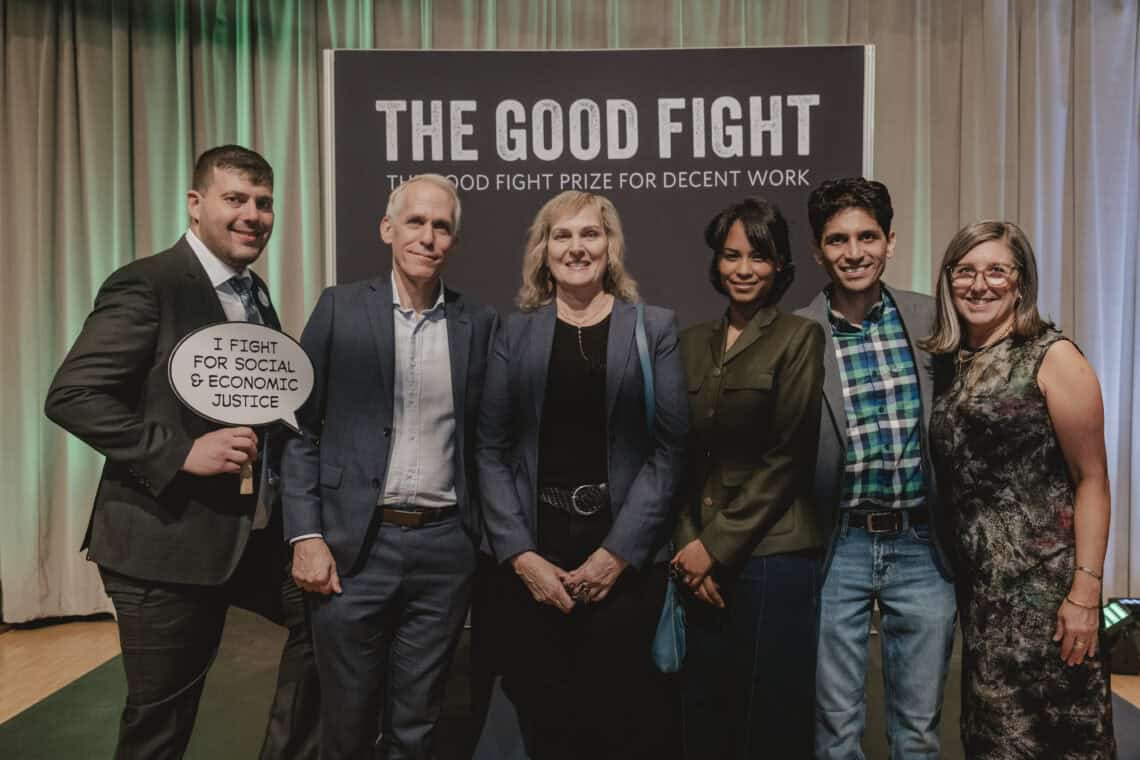
The non-profit helps bring different organizations together to collaborate where there’s an opportunity to make changes bigger than any one could effect on their own.
“Working with the Atkinson Foundation,” Thomas says, “their mission is highly focused on decent work,” which study after study has shown benefits the companies that adopt it. “That’s something that has material value to the companies themselves,” Thomas says. “With that in mind, we’ve been able to organize the Global Labour Rights investor network, which has something like $5.5 trillion in assets behind it now, which, I think, is pretty strong evidence that investors see it as a value-driven thing and not just a values-driven thing. Opportunities like that are what we’re set up to discover and help develop.”
Despite the volatility of the global financial landscape, Thomas says he doesn’t see people across Canada, and especially in the philanthropic sector, retreating. On the contrary, they’re getting more excited about the things they can do as investors. “That’s exciting to me,” he says. “I think there’s great opportunity, and it’s something we’ll continue to push forward if we can.”
Living-wage work in the green economy
The second finalist, the Youth Climate Corps campaign, a national campaign led by the Climate Emergency Unit (of the David Suzuki Institute) and the Small Change Fund, is also about decent work.
The campaign mobilizes young people across Canada to demand a permanent, large-scale training program guaranteeing living-wage, unionized work in the green economy. It tries to tackle both skyrocketing youth unemployment and the climate emergency by creating jobs in renewable energy, building retrofits, ecosystem restoration, emergency response, and community aid.
The under-35 demographic would apply and get two-year-long paid training to do climate adaptation and mitigation work. “This public jobs program draws inspiration from the Roosevelt era, where millions were hired post–World War Two in the US for reconstruction work to help build the economy,” explains Bushra Asghar, co-director of the national Youth Climate Corps campaign. “A lot of those folks built the US parks system at the time.”
[The Good Fight prize] speaks to our strategy and how we’ve been able to build broad-based coalition support outside of the climate movement.
Bushra Asghar, Youth Climate Corps
Fresh off securing a two-year, $40-million federal pilot in Budget 2025, the campaign was also recognized by the Atkinson Foundation. “It speaks to our strategy,” Asghar says, “and how we’ve been able to build broad-based coalition support outside of the climate movement, bringing on board labour unions, student unions, and faith groups calling for the creation of a youth climate corps nationally.”
What Asghar considers the best part of their campaign is its intersectionality. “We’re not just talking about climate in a siloed way,” she says. “We’re talking about bread-and-butter issues. Young people literally can’t make rent, we can’t afford to live in our cities, food is expensive. It’s about marrying this existential crisis of the climate emergency, which often gets pushed aside when you’re talking about people not being able to meet their material needs, and it brings them together.”
The campaign is based on the simple premise that we can deal with the climate emergency while also taking care of people’s material needs by giving them jobs in the exact sectors we need to be investing in right now.
Doing things differently
Asghar is grateful to both the Atkinson Foundation and the Definity Foundation, for their financial support and campaigns and their willingness to trust young people. “I’m really humbled to be trusted to do this work,” she says. “They always treat us as experts in what we’re doing. That means a lot.” She encourages young people to “kill their internal imposter syndrome” and fight for the causes close to their hearts. “I know the process of asking for money may feel daunting,” she says, “but find the people who care about the causes that you care about and raise the money that you need to do the really cool things you’re capable of.”
Encouraging young people in a foundation space, which tends to skew older, was another reason why the prize recognition felt special to them. “The lasting win for us,” Asghar says, “is that a lot more young people now believe that they can create change around any issue that matters to them.”
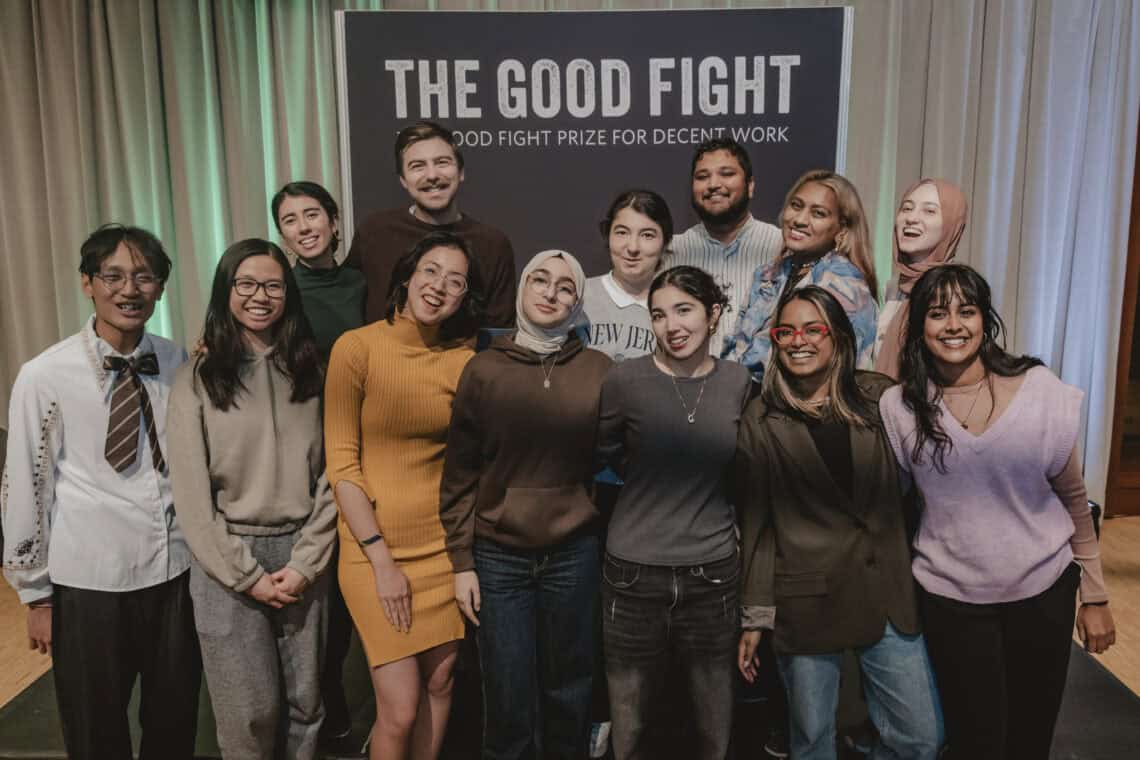
Being encouraged to do things differently is also one of the messages communicated with the Good Fight Prize. “Does being an advocate mean that I have to put on a blazer and present a very formal, polished approach?” asks the Worth More! campaign’s Carolyn Ferns. “What we wanted to tell people is that you don’t have to shut off that part of yourself that cares about people to be effective. The education sector is a 70%-women-dominated field, and this campaign built on parts of feminist advocacy history.”
Why investing in movement building matters
“One of the things we really understand at the Atkinson Foundation is that a private trouble is actually a public issue,” Murphy says. “To be able to connect those dots is really why our foundation focuses on this idea of movement building. Organizing across individuals, groups, and interests to build power and sustained action towards the same goals, like better wages and work conditions, a fairer immigration system, affordable housing, and environmental sustainability.”
In troubling times, this kind of collective energy generates hope and builds awareness but also challenges the status quo and invites alternatives. “We have an opportunity as funders, as investors, to play a really important role in supporting people to engage in collective action,” Murphy says. “To invite people to use their democratic power in common cause, not only at the ballot box, but also in between to create change around things that matter most.”
We have an opportunity as funders, as investors, to play a really important role in supporting people to engage in collective action.
Colette Murphy
The Good Fight celebrates broadly based community campaigns often led by people who have direct experience with the issues they’re trying to solve.
“We’re so proud of all three finalists,” Murphy says. “It was a really, really challenging decision for the committee.” Worth More! is the first in a series of annual winners going forward, both for the difference they’re making for childcare workers and the greater impact those wins will have on children and families into the next generation.
“We’re so impressed with how the campaign has mobilized thousands of childcare workers to demand better,” Murphy says. “Because we know that care work is the work that makes all other work possible.”
Moving forward in coalition
What does the prize recognition mean for three very different campaigns?
“We’re delighted to be recognized,” SHARE’s Thomas says, “but we were a little reluctant because the real ‘good fight’ is one workers are taking on with employers and systems around core labour standards and decent work. People who organize at that grassroots level put themselves at great risk and are often very vulnerable. They’re really fighting the good fight.”
What SHARE does well, according to Thomas, is find ways to help align a lot of interests around a common cause. “I don’t know if that’s a good fight or just good work in general,” he says, “but it’s something we’re deeply grateful to be able to do and grateful for the Atkinson Foundation’s support.”
What Asghar from the Youth Climate Corps finds rewarding about being both a prize finalist and a grantee is the Atkinson Foundation’s acknowledgement that the fight for decent work and the fight for climate emergency are inextricably linked. “That’s one very big highlight for me,” she says, “because a lot of labour unions don’t get the climate emergency in this country, and a lot of young people don’t understand labour politics not understanding the climate emergency. The two are extremely tied together.”
Ferns says the organizations and core people who worked on the Worth More! campaign are using their prize money to launch a brand-new campaign, Care Counts. “Something worked here that resonated with people,” she says. “How do we lean in to that, and how can we use the prize money to help do that?”
The new campaign is about how caregiving is worth more – for families, but also for the economy. “We want to build more collaboration across care sectors,” Ferns says, pointing out that the childcare movement in Canada is something that happens in coalition. “You can’t make that change alone,” she says. “You need as big a tent as possible, as many people as possible, talking together, putting their messages out together.”
A movement is about collective work and energy, and transformative change requires a mindset of long-term.
Colette Murphy
Murphy warns that foundations need to recognize this kind of work as long-haul work. “There will be wins, but there will be losses and setbacks,” she says. “A movement is about collective work and energy, and transformative change requires a mindset of long-term.” What she believes the three finalists and two previous winners (the Fight for $15 & Fairness Campaign in 2017, and the Toronto Community Benefits Network in 2022) embody are the breadth of how this movement is seeding real change and strengthening the threads of democracy and the vision of a good life for all by centring the idea that decent work is the foundation of a good life and a healthy society.
“This work is more important than ever,” Murphy says. “Whether you’re a young person, a childcare worker, or an institutional investor, we need to share in the work of supporting people who engage in collective action and who are building up the kind of democracy that some in the world want to tear down today. That’s part of our role as funders.”