Though some governments and funders shying away from DEI are dominating headlines, the Anima Leadership CEO and co-founder proves that workplace equity is more than just in demand – it’s necessary.
Annahid Dashtgard is playing the long game. Her most recent move, nearly 20 years in the making, is a book for racialized leaders.
As CEO and co-founder of Anima Leadership, which trains organizations and companies to build cultures of belonging, she is unapologetic about its pursuit of diversity, equity, and inclusion. Despite rebranded or rolled back DEI initiatives and commitments, last year’s removal of DEI policies across the US Foreign Services, and shrinking data disclosure in Canada, Dashtgard refuses to believe DEI is dead. “As long as we have inequity and discrimination happening, there’s going to be a need for this work,” she says. “The need is greater than it has ever been before, even though the resources for it are less than they were 10 years ago.”
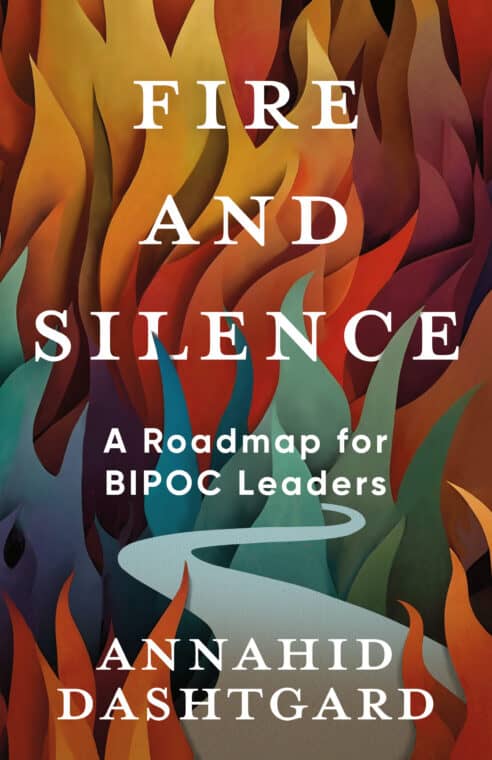
And therein is the spark behind Dashtgard’s book, Fire and Silence: A Roadmap for BIPOC Leaders (available from Dundurn Press). In her introduction, Dashtgard takes roll call: Are you racialized? Are you a professional leader or seeking leadership roles? Do you want to interrupt systems of oppression? If you answered yes to any of these questions, Fire and Silence is for you. But before you begin wondering if the book will help you encourage your organization to make its five-year strategic plan more radical, Dashtgard sets the record straight: you are not the problem. For all the racist tensions and microaggressions endured, she refuses to let readers internalize these as personal failures. She names and challenges the layered racism, sexism, and xenophobia that leaders shoulder (and sometimes perpetuate) in the Canadian workplace. Then the road trip begins. In four sections – Survive, Impact, Heal, Thrive – Dashtgard helps racialized leaders build endurance for the journey to dismantle the oppression that targets their communities.
Refusing to internalize racism
When Dashtgard immigrated from Tehran, Iran, to a small town in Alberta as a child, she was immediately hyper-conscious of her race. It was the 1980s, few people looked like her family, and there weren’t many conversations about racism. Dashtgard believed she was to blame for the racial discrimination she experienced until she started noticing sexism at work in her early 20s. “It was connected to me being able to identify and name my own racial trauma from childhood, and that didn’t happen until my early 40s.”
When you can see the patterns, when you can name the patterns, you have voice to release yourself from it.
Annahid Dashtgard
Dashtgard writes about the importance of naming workplace racism as a means of survival. She shines a light on racist behavioural patterns and how racialized leaders can be blamed or set up to fail as a result. There’s gaslighting, tokenism, ambushing, scapegoating, over-surveillance, underpromotion, and white-lash (white people’s violent or hostile reaction to racialized people, and in the context of the workplace, when racialized people perform well or better than white people). “When you can see the patterns, when you can name the patterns, you have voice to release yourself from it,” Dashtgard says.
There’s also the time when Dashtgard – then in her 40s and on tour for her first book – was speaking on a panel with some other brown women, to be met by a white woman telling her how cute she was, and that she and her co-panellists could all be cousins. “It was so infantilizing,” Dashtgard says.
Fire and Silence follows Dashtgard’s 2023 essay collection, Bones of Belonging: Finding Wholeness in a White World, and 2019’s Breaking the Ocean: A Memoir of Race, Rebellion, and Reconciliation.
When Dashtgard published her memoir and spoke publicly about the racism she faced, some friends and neighbours began avoiding her and acting strangely. “I was really hurt by that. I didn’t expect it to happen, and I got very angry at some people,” she says. She refused to make eye contact or say ‘hello’ for a few years. Then she realized she didn’t want to operate that way. “I realized the boundary for me is: I don’t want to be in close contact, I don’t want to let those people into my personal life. I understand it wasn’t intentional for a lot of them, and I want to carry myself in a way that represents my values. And so I will say ‘Hello’ and ‘How are you?’ to find a place where I’m humanizing the other person without necessarily having to like them or be in relationship with them.”
The benefits of learning and leading together
Instead, Dashtgard saw the importance of having spaces for racialized people to affirm their experiences. So, in 2022, she co-created the BIPOC Leader Lab, where cohorts of racialized leaders learn how to navigate and thrive in their leadership journeys. They also examine white cultural norms in the workplace that people may struggle to align with, like putting the individual over the collective, and urgency over wisdom, and prioritizing binary frameworks.
Dashtgard writes about resisting victimhood by channelling power from marginalized identities. Cultural competencies, adaptability, and adopting justice mindsets are some areas where Dashtgard finds that many racialized leaders excel. In her experience, racialized leaders’ diverse community experiences paired with their intimate knowledge of discrimination allows them to anticipate and respond to cultural and contextual differences more easily. “I experience sexism and racism pretty regularly still in the rooms that I’m in, and I recognize that that is operating, but I also recognize that if I go into just feeling the victim of it, I’m not going to have impact,” she says.
Dashtgard says she can encourage leaders to be vulnerable with each other because she has done the work herself. She admits she could not always forgive people who mistreated her, instead choosing to “move in and out of compassion.”
“I think when we can’t forgive at all, the risk is that we dehumanize the other person, and then basically, we’re creating another loop of oppression, just like we ourselves have experienced. Because the heart of any oppression is dehumanization, right?” Dashtgard says. “How do you get to a place in yourself where you’re not dehumanizing? [It’s] the place where you also liberate yourself a little bit more from carrying around that anger that is holding you back.”
Don’t preach to others where you haven’t gone yourself or you’re not able to go.
Annahid Dashtgard
The experiences of BIPOC Leader Lab participants informed Fire and Silence, including testimonies about learning from difficult decisions, feeling antagonized by colleagues, knowing when to leave a role, and even being afflicted by fellow racialized leaders. So, when Dashtgard advises leaders to seek affinity groups for racialized people, she does so with years of examples telling her it’s the right call. After all, similar networks of relationships are how white leaders have been able to stay in power for so long. “Undoing the harm caused by millennia of power structures set up to favour rich white men doesn’t happen single-handedly,” she writes. “It takes collective organizing and strength. And also means undoing the internalized belief that many of us carry that we have to go the path alone.”
When seeking a group like this, Dashtgard suggests paying attention to how you feel when you join it: Are you celebrated or do you feel hyper-conscious? How do people respond to mistakes in the group? Is there an invisible rulebook you are expected to follow? Dashtgard says the group leader or longest-standing members should “walk their talk”: “I think part of the older model – the patriarchal, white model of leadership – has always been to talk down, like you’re in the ivory tower and you’re going to preach what should be done to your subjects,” Dashtgard says. “Don’t preach to others where you haven’t gone yourself or you’re not able to go.”
Healing as an overlooked part of leadership
While writing about leaders’ survival and impact was “cathartic” and “clarifying” for Dashtgard, she didn’t have the same response for the chapters on healing. “I deeply believe all leaders need to go through some amount of a healing journey, because what parts of ourselves we don’t reckon with, we are greater at risk for putting on to others, or projecting on to others,” she says. But it was difficult for her to decide how to speak about healing in a leadership book.
However, direct managers are among the most frequent sources of workplace trauma, according to a research partnership with Mental Health Research Canada, Canada Life, and Workplace Strategies for Mental Health. In a study of 5,500 employees, 27% indicated that managers traumatized them, while 29% and 46% identified co-workers and clients, respectively. “Then I realized, ‘Annahid, you’re writing the book that is the answer’” to these “patriarchal, white supremacist workplace norms, which are all about placing the intellect above any other way of knowing, especially more embodied ways of knowing. So you have to put that chapter in.”
I deeply believe all leaders need to go through some amount of a healing journey.
Annahid Dashtgard
Dashtgard studied adult education and psychology, but she is also certified in conflict facilitation, trauma recovery, and traditional Chinese medicine. The aforementioned chapter is about befriending the body. Dashtgard writes about managing triggers, reckoning with trauma, rest as revolution, and navigating the inevitable backlash that racialized leaders receive. “I do think leadership calls us to work with our pain places in a different way, and we have a greater responsibility to do our own healing so that we’re not caught in that place of victimization all the time,” she says. “Many leaders of colour haven’t done their internal work, and they create their own versions of toxicity. This idea that just because you’re racialized or just because you’re female, you’re going to get into leadership and do it differently because you’ve been the victim of the misuse of power is such a fallacy.”
Several factors affect the type of leader someone can be, such as professional and lived experiences, board support and organizational culture, social inclusion, a leader’s proximity to burnout, and more. Though an organization led by someone with a marginalized identity is more likely to be inclusive, research shows that it is not a guarantee. “Those of us that have been most wounded by the misuse of power have the greatest potential to learn how to use it,” Dashtgard says. “The caveat to that is you have to do the inner work, the inner reckoning. And I think that’s some of the hardest work in leadership. It takes a lot of self-refection.”
Embracing DEI amidst the backlash
On average, racialized people in Canada hold 10% of board positions and 10% of senior management positions. Retreating DEI funding and support threatens women, marginalized communities, and the capacity of non-profits intending to support them.
“If you look at history, shifting systems of oppression is [a] lifetime game,” Dashtgard says. “The ‘DEI is dead’ argument is a right-wing argument. It’s a political argument. It’s not a reality.”
While Benefits Canada reports that a survey found that 23% of employers had reduced or eliminated DEI programs, 78% had a documented DEI strategy or one in progress. Anima Leadership’s latest blog says that according to studies from the Diversity Institute and Abacus Data, DEI has helped 47% of younger Canadians, 38% of women, and 55% of racialized people. The data also says that 56% of women and 59% of racialized people are likely to see DEI as a positive impact on society.
“Since George Floyd’s murder, we’re further ahead than we were before. There’s still more. I think we did reach a tipping point,” Dashtgard says. She notes that though some organizations have retracted their DEI policies, particularly in the United States, Canada is “further ahead. It’s more entrenched in our public service performance grids,” she says. “We have our Employment Equity [Act] . . . I’d say there’s more organizations doing it quietly and steadily than before.”
In 2022, the Public Service Commission of Canada launched the Diversity and Inclusion Compass to track employment equity and support human resource and hiring managers in addressing how people are represented across workplaces.
Still, Dashtgard says the work around equity is “uncertain.” Anima Leadership will continue to train organizations and leaders, but Dashtgard is especially drawn to workplace restoration, which focuses on repairing damaged relationships, improving team cohesion, and stewarding organizational changes. It’s hard to create equity when people don’t feel included in toxic or mistrustful workplaces, she says; restoration efforts help re-establish trust so everybody benefits. “I love that work and I feel like it pulls on all the different things that I’ve done over many years. It feels rewarding.”