A partnership between a family foundation and a grassroots charity demonstrates what happens when two organizations trust each other enough to shift power, follow community wisdom, and explore an idea without prescribing what it must become.
Three years ago, Playful Mindset and Happy Roots Foundation quietly began a bold experiment. It didn’t start with a call for scale, a demand for metrics, or a set of predetermined outcomes. It started with a question, and an invitation: What happens when two female-led organizations – one private funder and one grassroots charity – trust each other enough to shift power, follow community wisdom, and explore an idea without prescribing what it must become?
That question, and the funding relationship behind it, has become the heart of a growing movement to transform how mental health support is imagined and experienced in Canada.
Happy Roots Foundation is a private family foundation focused on funding upstream, preventative approaches that nurture infant and early-childhood mental health. Playful Mindset is a national charitable organization that works early in children’s lives to disrupt adverse childhood experiences and support child and caregiver mental health through outdoor play.
Our organizations came together around a shared vision: to nurture infant and early-childhood mental health by fostering secure connections between young children and their caregivers and by creating early supports that interrupt cycles of adversity before they become entrenched. Playful Mindset’s work is grounded in the belief that outdoor play can be a powerful site for healing, supporting nervous-system regulation, connection, and mental health for both children and the adults who care for them.
What began as a small seed grant to support Playful Mindset’s charitable application and early start-up evolved into a one-year core operating grant, and later into a three-year commitment that was subsequently accelerated into a two-year grant. This progression allowed the work to move from idea, to pilot, to a stable and responsive organizational foundation – without rushing or forcing premature scale.
Our funding relationship is characterized by ongoing dialogue and transparency, in service of disrupting adverse childhood experiences with impacts that can extend into adolescence and adulthood. By supporting children early and strengthening caregivers in their relationships with them, we aim to interrupt cycles of adversity that can otherwise be passed from one generation to the next. Through outdoor, play-based experiences, Playful Mindset supports the mental health and well-being of children 12 and under and their caregivers, recognizing that caregiver regulation, connection, and support are foundational to children’s long-term resilience.
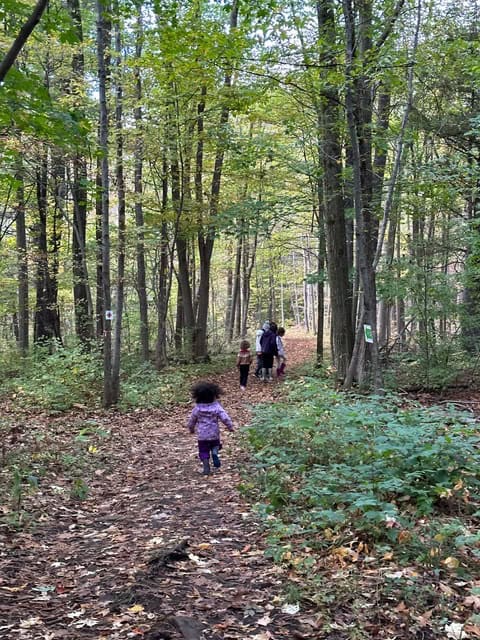
Playful Mindset’s first pilot program, the Outdoor Play Grief Group, was launched to support children and their caregivers navigating grief through outdoor play; the connection and feedback from families quickly revealed both the depth of community need and the strength of the model. From that initial program, we piloted and launched an Outdoor Play Perinatal Support Group and later developed an Outdoor Play Support Group for women and children who have experienced intimate partner violence, with the first cohort preparing to launch. As pilot programs, each offering runs for 10 weeks, with groups meeting for two hours per week. Children and caregivers participate concurrently in separate groups on the same land, supported by a multidisciplinary team of outdoor-play support facilitators – including playworkers, educators, counsellors, and therapists.
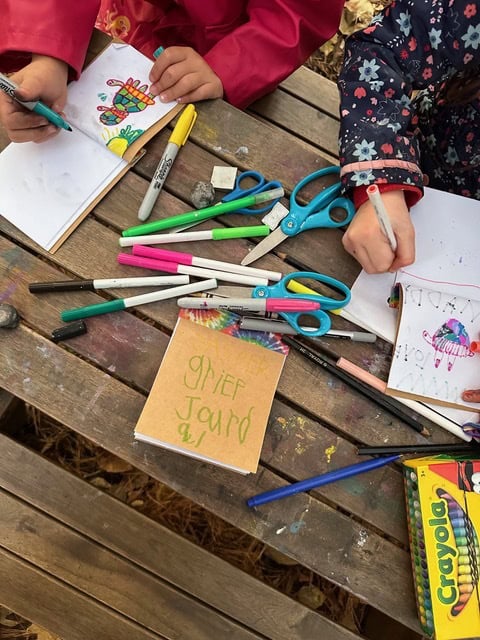
The aim is connection: to self, to one another, and to the land. These outdoor spaces become containers where caregivers can process what they have been carrying – grief, trauma, stress, changing identities, pre- and postpartum mental health challenges, rupture – and explore how these experiences shape their nervous systems, parenting, and day-to-day lives. For children, play becomes the primary language through which they make sense of what is unspeakable, overwhelming, or too heavy to hold alone. Across all programs, the model is consistent and intentional: the structure is intentionally light, allowing space for emergence, while the container itself is carefully held as a safe space for all participants
This was the first place where my child didn’t have to explain anything – and neither did I.
Playful Mindset participant
In these spaces, we are creating room for what is often left unprocessed – for children and caregivers alike. As one facilitator reflects, “Nothing is forced here. We’re holding the messy, the joyful, the quiet, the overwhelming – and trusting that play and presence will do the work they know how to do.” At the same time, participants are connecting with the land and with one another as resources for nervous-system regulation, insight, and movement through experiences that might otherwise keep them stuck. As one caregiver describes it, “This was the first place where my child didn’t have to explain anything – and neither did I.”
From this work have flowed more traditional markers of success. To date, Playful Mindset has developed and piloted three distinct outdoor-play support group models and delivered five grief groups and three perinatal support groups, with an intimate-partner-violence support group launching imminently. More than 100 children have been directly supported to date, alongside their caregivers – effectively doubling the program’s reach and impact.
These outputs matter. They demonstrate reach, stewardship, and organizational maturity. But impressing ourselves – or others – with outputs was never the purpose of the grant. Most crucially, what emerged from this partnership was a new way of thinking about care – one rooted in play, in community, in land, and in the agency of children and caregivers themselves.
Philanthropy that shifts power, not just money
The seed funding from Happy Roots was deliberately structured to transfer trust and decision-making power to the people closest to the work.
In place of rigid deliverables, there was spaciousness. In place of a prescriptive strategy, there was permission. In place of a top-down funding model, there was shared leadership, open dialogue about the highs and the lows, and creative solution-making – two female-led organizations co-creating something new.
“Happy Roots embraces trust-based philanthropy with an entrepreneurial lens, a reflection of our founders’ roots,” executive director Monique Moreau says. “Although operating without a traditional playbook can feel messy at times, we trust that this is where the magic of innovation happens. And that the greatest innovators are the experts in the field who know what needs to be done.”
Although operating without a traditional playbook can feel messy at times, we trust that this is where the magic of innovation happens.
Monique Moreau, Happy Roots Foundation
This power-shifting approach has allowed Playful Mindset to test, evolve, listen, and grow at the pace of real relationships, not funding cycles. It has opened the door to upstream, community-rooted mental health supports that would not have been possible within conventional philanthropic models.
Innovation didn’t come from scaling fast. It came from slowing down, listening deeply, and letting community shape what mattered. “The best funding relationships leave room for the unimagined – for discovery, uncertainty, and for funders and organizations to ‘play’ together and see what becomes possible,” says Marnie Power, CEO of Playful Mindset. “Like our outdoor-play support groups, we create the conditions for play to emerge, and from that, something far greater unfolds than we could ever plan for.”
What we learned when we let children lead
The work began with a simple intuition: that outdoor play could support grieving children and caregivers, and perhaps even prevent crises before they take root. Two years later, we know this to be true. Not through clinical endpoints, but because of what we witnessed – in forests, in kitchens, in neighbourhood parks, and in early-years centres across the country.
Play is a language for healing. Children make sense of their world not through talk therapy, but through mud, imagination, movement, and shared wonder. When adults meet them there – with presence instead of pressure – healing unfolds without forcing it.
Healing happens in relationship. When caregivers are supported, regulated, and not alone, children feel it in their nervous systems. And the land itself becomes a co-regulator – offering safety, rhythm, and a sense of belonging that many families have been denied.
Connection builds resilience. Resilience doesn’t come from avoiding hardship. It comes from not being alone in it. Play offers an immediate, joyful route back to connection.
Play can reimagine care. What began as grief support has become a model for accessible, non-institutional, culturally grounded mental health support – embedded directly in community spaces.
Prevention is possible. When support arrives early – before systems intervene, before crises escalate – children and caregivers thrive. The impacts of early adversity don’t need to define lifelong outcomes.
A shift in culture
From this quiet experiment has emerged a community-rooted model for trauma-informed, relationship-centred mental health care; programming shaped by the wisdom of local environments and cultures; accessible healing spaces in housing communities, early-learning centres, and community hubs; and a deeper societal recognition that play is not frivolous – play is foundational.
This approach is not about filling gaps in a broken system but about reshaping the system altogether. And that reshaping begins with shifting how power flows through our philanthropic and charitable sectors.
Why power-shifting matters for the future of mental health
For decades, charities have been asked to innovate while being tightly constrained – by short-term grants, rigid evaluations, and top-down agendas. This has especially affected women-led organizations working at the intersections of care, culture, and community. The Playful Mindset–Happy Roots partnership challenges that pattern. It demonstrates that trust-based philanthropy is not only possible but catalytic.
When funders support organizations as both thought partners and service providers, what emerges is:
- true innovation, not risk-managed replication
- community agency, not one-size-fits-all programming
- upstream solutions, not reactive crisis responses
- paradigm-shifting work, not temporary interventions
- leaders and teams who flourish, not practitioners stretched thin by survival-mode funding
This is how systems actually change: from the ground up, through culture, through relationships, through trust. As a direct result of this space and trust, Playful Mindset expanded beyond direct programming into several areas of innovation and systems-level work. This included the launch of the Play Security Project and the engagement of five to six new community partners; the early development of a trauma-informed, land- and play-based certificate designed for social workers, child and youth workers, early-childhood educators, counsellors, and therapists working in the community services sector, with the aim of embedding trauma-informed play practices into community-based care; and support for the early acquisition of a 100-acre farm and forest site, located just 15 minutes from downtown Ottawa, which will serve as a long-term home for land-based programming.
Looking ahead: What if what we are counting isn’t what matters?
If Canada is serious about improving children’s mental health, we must look at investments that reach beyond clinical interventions and include approaches that honour culture, agency, gender equity, and community wisdom. And we must recognize that the most innovative mental health work emerging today is coming from small, community-rooted, often female-led organizations – when they are trusted enough to lead, and when evaluation frameworks honour these deeper, experiential forms of change. What we measure should include not only outcomes, but relationships; attending to the subtle, human shifts that reveal whether healing is truly taking root.
As Playful Mindset enters its next phase of growth, we are not trying to build an empire. We are cultivating a movement where relationship is the method, play is the practice, place shapes healing, prevention becomes the norm, and communities co-create what care looks like.
And fundamentally: where philanthropy becomes a learning partner and evaluation becomes a practice of shared sense-making rather than surveillance. (See Murphy Johnson’s reflections on “Measuring What Matters” in the Systems Sanctuary report Scaling Deep: Shifting Power and Redefining Success.)
The Playful Mindset–Happy Roots partnership has shown how impact grows deeper when it grows in relationship. And it has shown that when we follow children – into forests, into play, into connection – we find a future worth building.